


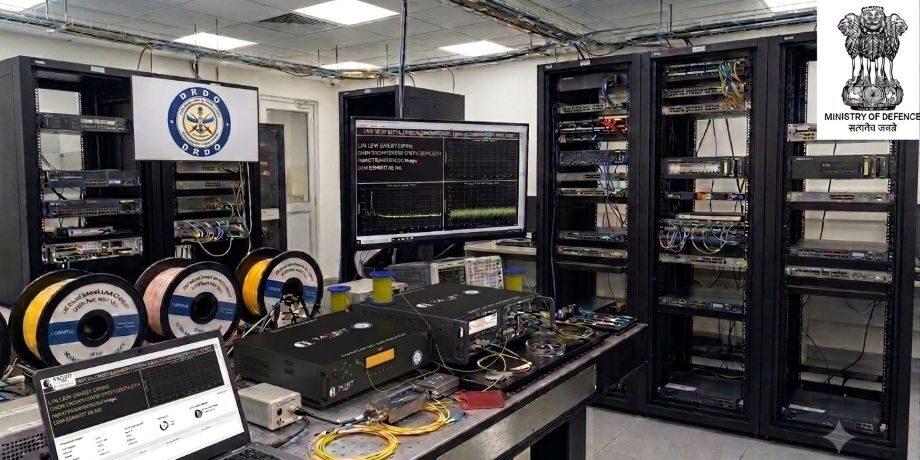
The Defence Research and Development Organisation has successfully validated quantum key distribution technology in field trials, marking a significant advancement in secure military communications for the Indian armed forces, according to DRDO.
Quantum key distribution, or QKD, represents a cryptographic approach that leverages quantum mechanical principles to detect eavesdropping attempts in real time. Unlike conventional encryption methods that rely on mathematical complexity, QKD uses photons to transmit encryption keys, making interception theoretically impossible without immediate detection.
The successful field validation underscores India’s commitment to developing indigenous quantum communication technologies for defence applications. As adversaries worldwide invest heavily in quantum computing capabilities that could potentially break existing encryption standards, QKD offers the Indian military a pathway to communication security resistant to both current and future cryptanalytic threats.
DRDO’s validation of QKD in operational conditions is particularly significant given the technological challenges involved. Quantum systems require precise calibration, environmental stability, and integration with existing military communication infrastructure. Field trials assess whether laboratory-developed systems can function reliably across varied terrain, weather conditions, and operational tempos that characterise actual military deployments.
India’s pursuit of quantum communication technologies aligns with broader national strategies to reduce dependence on foreign defence systems. The Make in India initiative has prioritised indigenous development of critical technologies, and quantum communication falls squarely within this framework. Successful indigenisation of QKD would allow the armed forces to maintain operational security without reliance on external technology providers or supply chains.
The validation also reflects India’s positioning in the global quantum race. Nations including the United States, China, Russia, and European countries have established dedicated quantum communication programmes and national quantum strategies. India’s advancement in QKD demonstrates the DRDO’s capacity to develop cutting-edge technologies in domains previously dominated by technologically advanced nations.
Military applications of validated QKD extend across command-and-control networks, intelligence transmission, and strategic communications. For the Indian Air Force and Navy, whose operations depend on secure real-time information exchange, QKD offers enhanced protection against signal intelligence collection by adversaries. The technology could be integrated into networks serving forward air controllers, maritime patrol aircraft, and submarine communications.
The successful field validation opens pathways for operational deployment across the three services. Integration with existing secure communication infrastructure, training of personnel, and development of service-specific protocols will determine the timeline for widespread adoption. DRDO’s validation represents a critical step toward making India’s military communications quantum-secure and advancing the nation’s technological sovereignty in defence.