


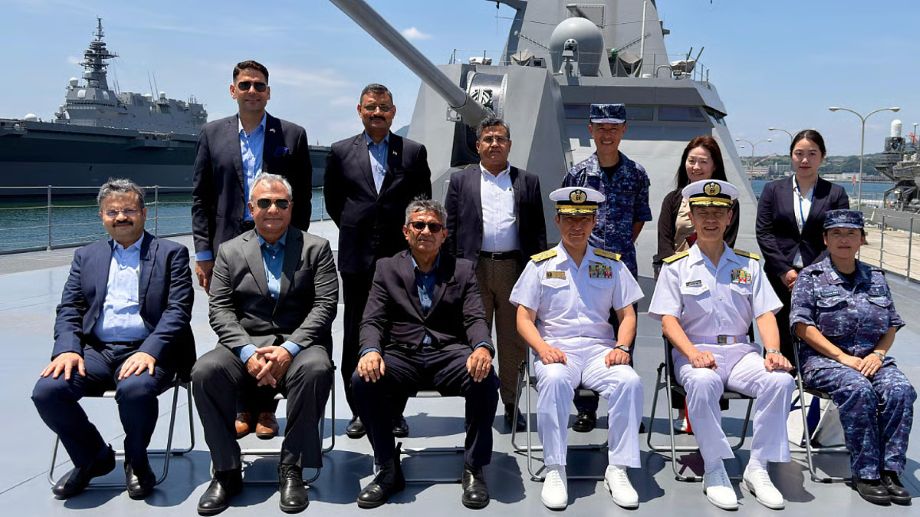
Defence Secretary Rajesh Kumar Singh visited Japan’s JS Niyodo, the seventh Mogami-class stealth frigate, at the Kure naval base in Hiroshima as Tokyo pushes forward with its proposal to build the warships in India under the Make in India programme, according to the Defence Ministry.
Singh held wide-ranging talks with senior Japanese officials during the eighth India-Japan Defence Policy Dialogue, co-chaired with Japan’s Vice Minister of Defence for International Affairs, Kano Koji. The two sides reviewed the full spectrum of bilateral defence cooperation, including maritime security, cyber, space, advanced technologies, and defence manufacturing.
The visit underscored India’s active evaluation of Japan’s Mogami-class proposal, which marks a significant departure from Japan’s traditionally restrictive defence export policy. Tokyo has offered to transfer the frigate’s design, production rights, and critical technologies to India, with integration of Indian systems such as the BrahMos supersonic cruise missile under discussion, according to Defence Ministry sources.
The Mogami-class represents Japan’s latest-generation surface combatant design, featuring advanced stealth characteristics that reduce radar cross-section and acoustic signatures. Displacing approximately 3,900 tonnes, these frigates are optimised for sustained anti-ship, anti-submarine, and air-defence operations across extended oceanic deployments. The design incorporates modular architecture allowing integration of foreign-origin systems, a flexibility that underpins Japan’s offer to indigenise production in India.
India’s evaluation of the Mogami-class proposal aligns with the Indian Navy’s ongoing modernisation trajectory. The service operates eight Shivalik-class stealth frigates and is inducting the Nilgiri-class frigates, a domestically designed programme based on the Guided Missile Frigate (GMF) project. The Mogami-class, if acquired, would augment India’s fleet at a higher capability threshold, particularly in anti-air and electronic warfare domains, complementing both indigenous and Western-sourced frigates already in service.
The technology-transfer and local-production arrangement addresses India’s long-standing strategic objective of building indigenous naval capability while accelerating access to mature, operationally proven designs. Japanese defence manufacturers have historically supplied high-reliability systems; integrating them with Indian platforms such as BrahMos reflects the deepening industrial collaboration between New Delhi and Tokyo.
Singh also toured Japan’s Joint Operations Command on July 13, underscoring growing operational cooperation and shared commitment to maintaining a Free and Open Indo-Pacific. Both sides agreed to deepen cooperation in emerging areas including cybersecurity, space, and advanced technologies, while stressing the importance of regular high-level military exchanges. The two nations are preparing for the next India-Japan 2+2 Foreign and Defence Ministers’ Dialogue, scheduled later this year.