

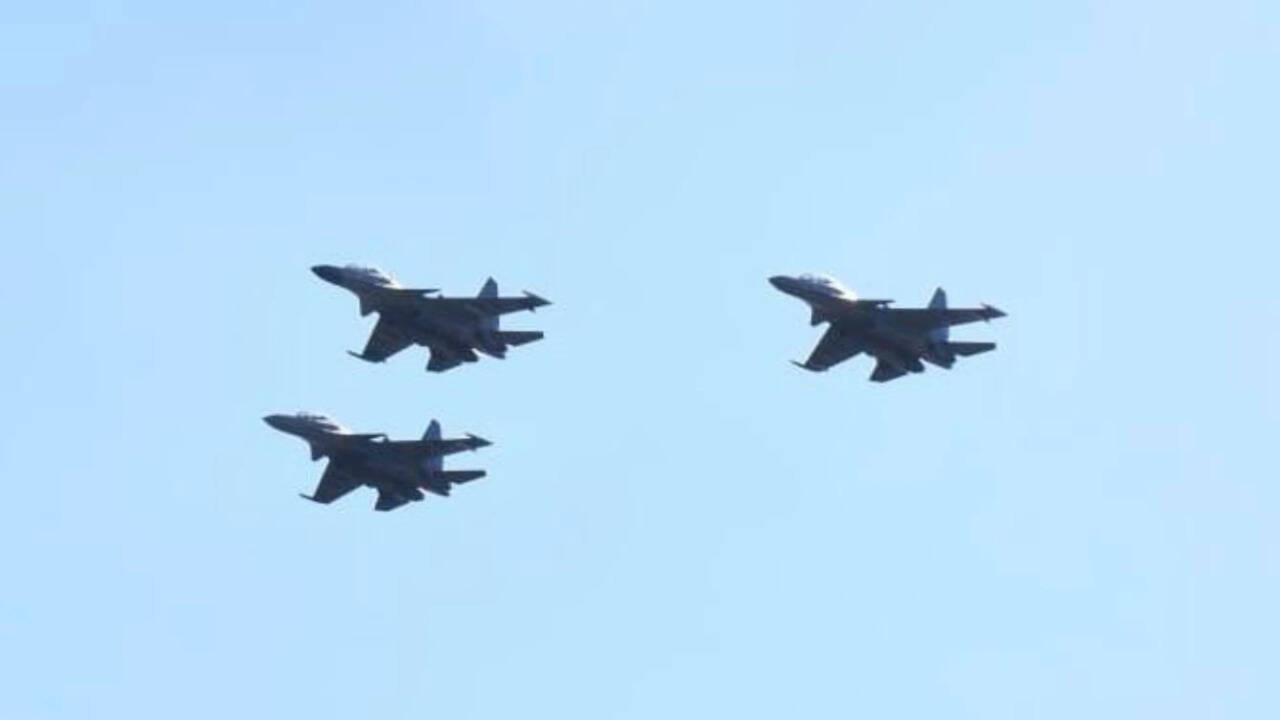
The Indian Air Force has been ranked third in global airpower for 2026 by the World Directory of Modern Military Aircraft, maintaining its position ahead of China’s People’s Liberation Army Air Force which ranks fourth. This marks the fifth consecutive occasion since 2022 that the IAF has outranked the PLAAF in the annual assessment.
The WDMMA ranking uses a proprietary True Value Rating system that evaluates 129 air services across 103 countries, tracking over 48,000 aircraft. The highest possible score of 242.9 is held by the United States Air Force. Russia ranks second overall, followed by the IAF in third position.
The TVR formula weighs fleet size, composition, modernisation, logistical support and overall capability, with particular emphasis on fleet mix and special capabilities rather than fighter quantity alone. The system also factors in order book strength and indigenous aerospace manufacturing capacity, areas where India has invested significantly through its Defence Acquisition Council and Make in India defence initiatives.
The IAF’s current fleet stands at 1,716 aircraft across seven fighter types, with 542 fighter airframes forming the largest segment. Helicopters comprise 498 rotary-wing platforms including the Mi-17, HAL Dhruv and Rudra variants. The service operates 282 transport aircraft and 374 trainers, with 20 special-mission platforms including airborne early-warning systems and aerial refuelling aircraft.
India’s helicopter fleet strength reflects the IAF’s operational priorities in counter-insurgency and internal security missions across difficult terrain. The Mi-17 series, acquired in bulk for utility and transport roles, has become a workhorse across the Himalayan region and Northeast operations. The HAL Dhruv and Rudra variants represent indigenous rotary-wing capability developed by HAL under the Advanced Light Helicopter programme, reducing dependence on foreign procurement and building organic manufacturing expertise.
The trainer fleet of 374 aircraft underscores the IAF’s commitment to sustained pilot development. These include the Hindustan Aeronautics-built Hawk advanced jet trainer, which forms the backbone of fast-jet training, alongside intermediate and basic trainers. The trainer component is critical for WDMMA’s assessment because it indicates institutional capacity to generate and sustain air power over time.
By contrast, the US Air Force derives 41 percent of its fleet from fighters and close-air-support aircraft, with helicopters forming only 4 percent of its establishment. The USAF allocates roughly 14 percent to special-mission aircraft, reflecting a fundamentally different operational footprint oriented toward power projection and strategic deterrence rather than regional air defence and internal operations.
India’s consistent ranking above China reflects the IAF’s modernisation trajectory through acquisition of the Rafale fighter, ongoing indigenous development of the HAL Tejas light combat aircraft, and sustained Su-30 MKI fleet upgrades. The order book remains robust with commitments to additional Rafales and indigenous fighter programmes, factors that favour India in the WDMMA assessment methodology.