


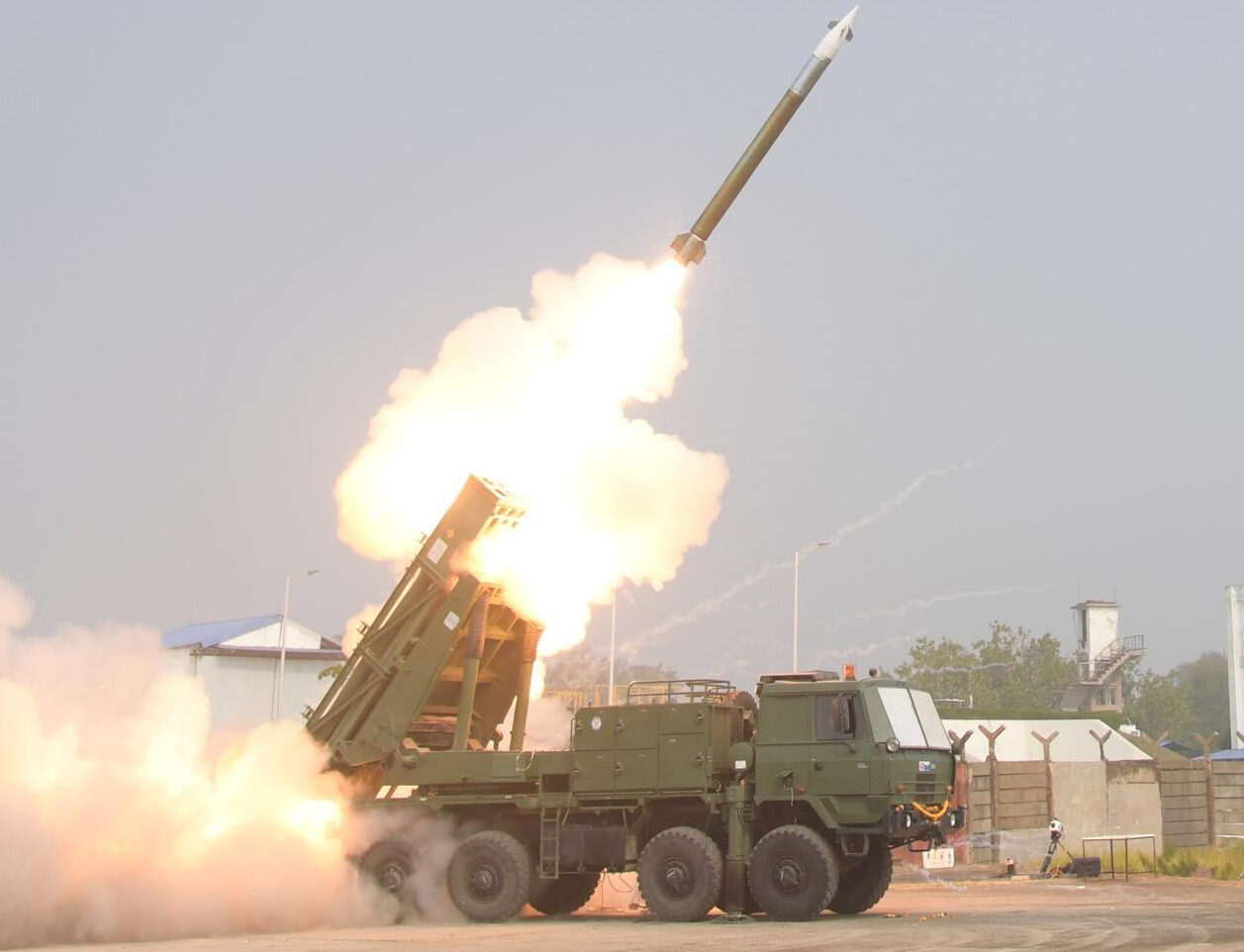
The Defence Research and Development Organisation successfully flight-tested the Pinaka Long-Range Guided Rocket (LRGR) from the Integrated Test Range in Chandipur, Odisha, demonstrating India’s advancing capability to strike targets with precision at extended ranges.
According to DRDO, the guided rocket hit its target with textbook precision during the trial. The system was tested for a minimum range of 60 km, with the upgraded variant expected to achieve a potential reach of up to 120 km. Significantly, the rocket was launched from an in-service Pinaka multi-barrel rocket launcher, eliminating the need for an entirely new platform to field this more capable weapon.
Pinaka, named after Lord Shiva’s mythological bow, has undergone a fundamental transformation since its induction into the Indian Army. The system entered service in the early 2000s as an area-saturation rocket launcher, designed to blanket targets across a wide geographical footprint. Its original 40-km range variants, the Pinaka-I and Pinaka-II, were optimized for massed firepower rather than individual target precision.
The introduction of guidance capability fundamentally reshapes the weapon’s operational doctrine. In modern warfare, range directly determines whether an army can strike critical infrastructure, logistics hubs, artillery concentrations, or command posts while remaining outside the enemy’s counter-fire envelope. The guided variant shifts the strategic calculus from area coverage to precision deep-strike effects.
The Pinaka system has proven its value across two distinct operational theatres. Along the northern frontier, it provides the Indian Army with a long-range organic fire support asset capable of engaging targets in high-altitude, challenging terrain. Along the western border, the system’s firepower density and range compensate for India’s numerical disadvantages in certain sectors, enabling asymmetric operational advantages.
The guidance upgrade positions Pinaka within the same capability envelope as modern guided multiple-launch rocket systems (MLRS) fielded by advanced militaries. Systems such as the U.S. HIMARS and the European MRLS can achieve circular error probable (CEP) measurements of a few metres at extended ranges, enabling surgical strikes against defended targets.
This evolution aligns with India’s broader defence indigenization strategy. Rather than acquiring foreign guided rocket systems, DRDO has methodically upgraded an existing platform, reducing acquisition costs and maintaining operational continuity. The Indian Army continues to induct Pinaka launchers across its artillery brigades, ensuring that the guidance upgrade can be fielded progressively across the existing fleet.
The test reinforces India’s emphasis on conventional precision firepower as a core element of its deterrence posture. Long-range guided artillery serves not merely as a support weapon, but as a battlefield controller, enabling commanders to shape operations at depth and deny adversaries freedom of movement.