


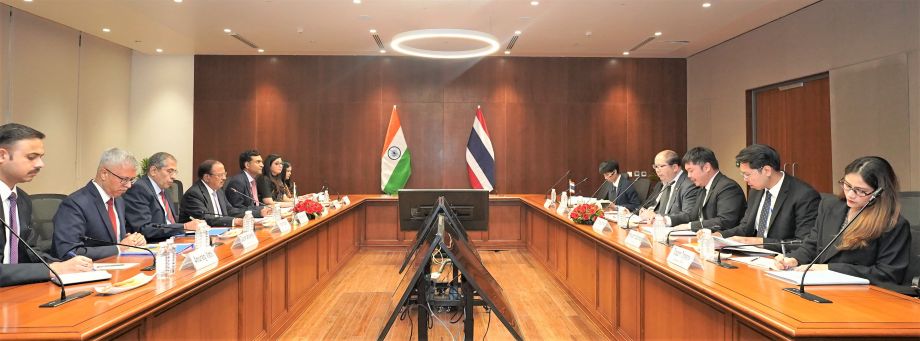
India’s National Security Adviser held key bilateral meetings with security leaders from neighbouring countries in advance of the BIMSTEC Security Summit. The consultations underscore New Delhi’s effort to build consensus on regional security challenges across South and Southeast Asia before the summit convenes.
BIMSTEC, the Bay of Bengal Initiative for Multi-Sectoral Technical and Economic Cooperation, comprises seven members: India, Bangladesh, Bhutan, Myanmar, Nepal, Sri Lanka, and Thailand. The bloc has emerged as a significant platform for sub-regional cooperation on maritime security, counter-terrorism, disaster management, and energy connectivity since its formation in 1997.
Bilateral consultations by the National Security Adviser ahead of multilateral summits are standard diplomatic practice in Indian strategic engagement. These meetings allow India to align positions with individual nations, address bilateral concerns, and build coalitions around shared regional priorities. In South Asia, such pre-summit talks are particularly consequential given the interconnected nature of security challenges spanning the Indian Ocean, the Hindu Kush, and the Bay of Bengal.
The timing reflects growing strategic competition in the Indo-Pacific region. China’s expanding presence in the Indian Ocean, maritime chokepoint vulnerabilities, and the geopolitical fallout from the Ukraine conflict have made BIMSTEC nations more attentive to security architecture. India has positioned itself as a net security provider in the region, offering capacity-building, defence cooperation, and infrastructure investments to member states.
India’s defence engagement with BIMSTEC partners includes naval exercises such as SLINEX (Sri Lanka-India naval exercise) and MILEX (Myanmar-India joint drills), as well as bilateral defence agreements covering training, intelligence sharing, and maritime surveillance. The Indian Navy has expanded port calls and joint patrols with littoral state navies to enhance situational awareness and counter-piracy operations.
Counter-terrorism coordination has been another pillar of BIMSTEC collaboration. The region faces persistent threats from transnational terror networks operating across porous borders, particularly in the India-Myanmar-Bangladesh triangle and along the India-Nepal border. Intelligence sharing and coordinated border security operations have become increasingly critical.
The security summit will likely address maritime domain awareness, cybersecurity threats, humanitarian assistance and disaster relief (HADR) coordination, and counterterrorism frameworks. Regional responses to climate-induced migration and resource competition over shared river systems are also expected to feature in discussions.
India’s role as chair or co-convener in various BIMSTEC working groups has allowed it to influence the bloc’s agenda. However, consensus-building remains challenging given divergent threat perceptions, bilateral disputes among member states, and varying relationships with major powers. The bilateral consultations ahead of the summit serve to navigate these complexities and ensure productive multilateral outcomes.