

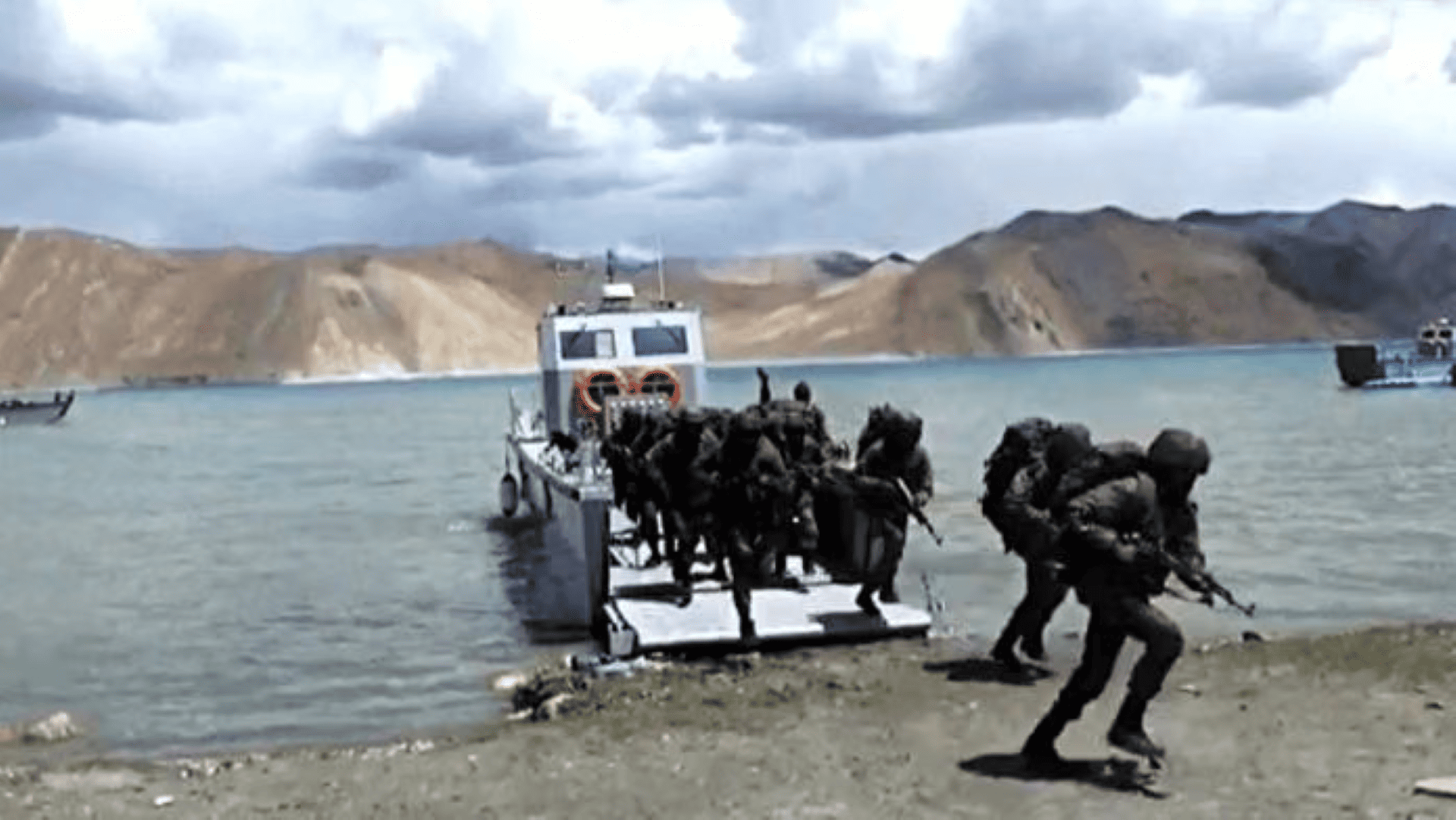
The Indian Army and Navy will induct high-speed amphibious combat boats capable of operating across water, marshland and firm ground along the Sir Creek sector and in the Andaman and Nicobar Islands, the Defence Ministry announced. The acquisition marks a significant step in addressing long-standing operational challenges in one of India’s most strategically sensitive maritime zones.
The Ministry of Defence has issued a Request for Proposal for nearly a dozen rigid-hull amphibious boats under the Buy (Indian) category, mandating at least 60 per cent indigenous content. Most boats will be deployed with the Army’s Corps of Engineers in Gujarat’s Kutch region, while the Navy will station the remainder at Mumbai and Port Blair.
Bidders have three months to submit proposals, with deliveries scheduled within 24 months of contract signing. The boats are designed for both combat and mobility, equipped with fore and aft weapon mounts and ballistic protection. They will exceed 40 knots at sea while carrying 12 fully equipped soldiers and over 1,500 kg of payload.
On land, the vessels will operate at 10-15 kmph using hydraulically operated retractable all-wheel-drive legs, negotiate gradients up to 15 degrees, and be transportable by heavy tank transporters as well as IAF IL-76 and C-17 aircraft for rapid deployment. These capabilities address a critical gap in India’s littoral and riverine operations capability.
The operational requirement stems from the unique challenges of Sir Creek, a 96-km tidal estuary separating Gujarat’s Kutch region from Pakistan’s Sindh province. The creek’s mudflats and shallow channels have long defied conventional movement. Conventional boats run aground during low tide, while wheeled vehicles become bogged down in slush. These amphibious platforms will enable troops to patrol, intercept infiltrators and insert teams across difficult terrain without losing mobility.
Sir Creek remains one of India’s most contested maritime zones. India maintains the international boundary runs through the creek’s middle, while Pakistan claims the entire waterway up to its eastern bank. The unresolved dispute has stalled maritime boundary demarcation and the Exclusive Economic Zones beyond.
The marshes around Sir Creek and the adjoining Harami Nala have historically served as smuggling routes and infiltration corridors for drug traffickers and Pakistani fishing boats. The vulnerability of India’s western coastline was brutally exposed during the 26/11 Mumbai terror attacks, when terrorists infiltrated by sea after hijacking an Indian fishing trawler.
Intelligence assessments have pointed to increased Pakistani military activity in the region, including new forward posts, fortified bunkers and military infrastructure. Current security relies on Border Security Force floating border outposts and occasional aerial surveillance, leaving gaps in persistent coverage and rapid response capability.
Amphibious combat boats represent a proven platform type in coastal and riverine operations globally. Nations with extensive wetland and delta security challenges have deployed similar systems for decades. India’s push for indigenous manufacture aligns with the Defence Ministry’s Make in India initiative, requiring local industry to develop or assemble these platforms with significant local content.
The Andaman and Nicobar Islands deployment underscores the strategic importance India places on controlling the eastern approaches to the Indian Ocean. These islands sit astride vital shipping lanes and represent India’s forward presence in the Indo-Pacific region.