

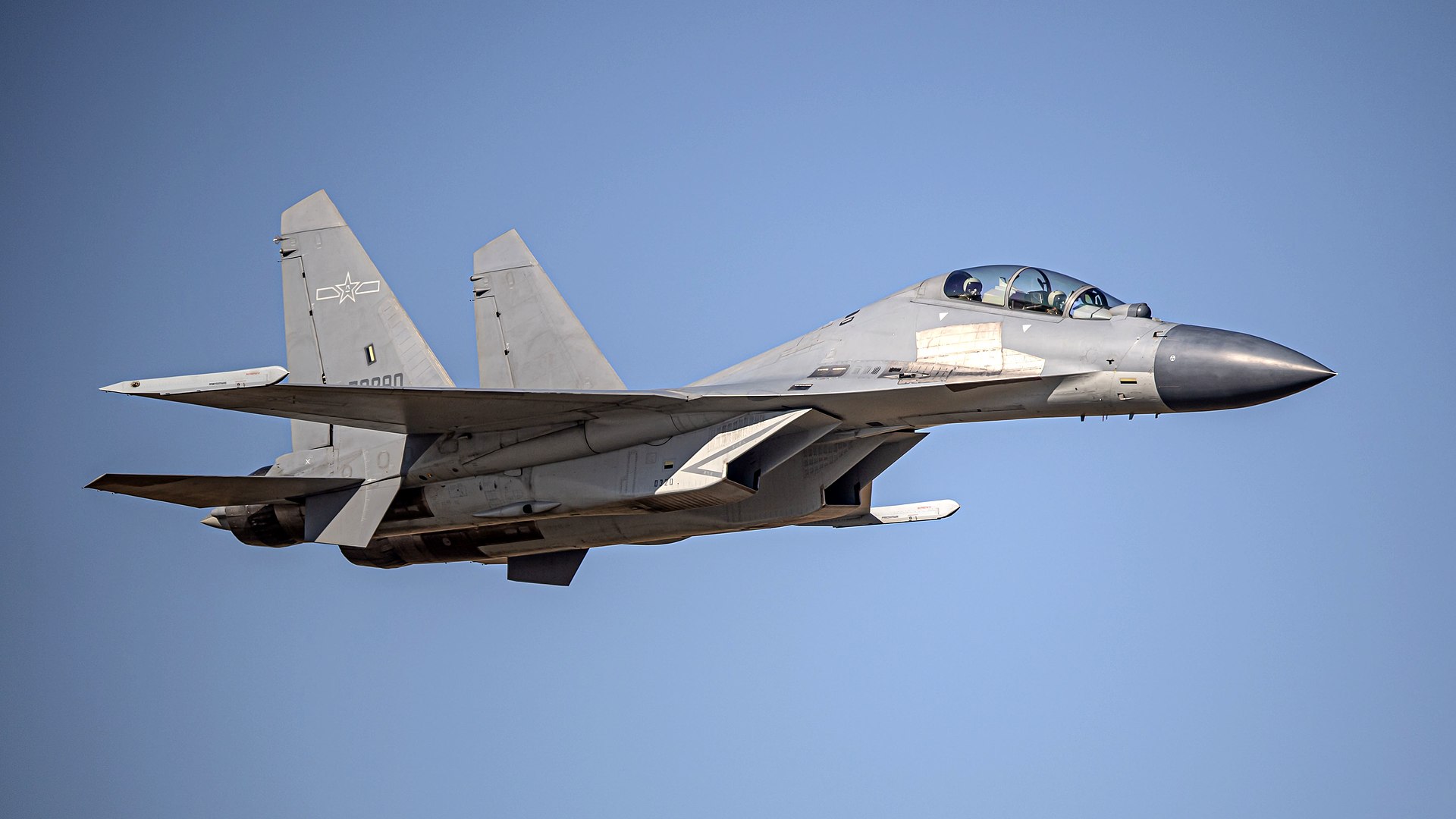
China has publicly demonstrated its Shenyang J-16 fighter jet carrying its heaviest air-to-air weapons load to date, a configuration defence analysts are calling “Beast Mode.” The loadout comprises eight PL-15 beyond-visual-range missiles and two PL-10 within-visual-range missiles, according to analysis published in the Chinese military publication Ordnance Science and Technology.
The configuration reveals the People’s Liberation Army Air Force’s strategic shift toward maximising firepower and sustained air-combat endurance. Chinese defence analysts describe the setup as transforming the J-16 into a high-capacity “missile truck” optimised for long-range aerial warfare and air dominance operations.
The J-16 is a twin-engine, twin-seat, 4.5-generation multirole fighter developed by Shenyang Aircraft Corporation. Derived from the Russian Su-30MKK airframe, it incorporates extensive Chinese upgrades including an Active Electronically Scanned Array radar, indigenous avionics, advanced electronic warfare systems, and domestically manufactured WS-10B turbofan engines.
The aircraft measures approximately 21 metres in length with a maximum takeoff weight of 35 tonnes. Its two WS-10B afterburning turbofans enable speeds exceeding Mach 2, with an operational combat radius around 1,500 kilometres. The J-16 features 12 external hardpoints capable of carrying up to 8 tonnes of ordnance.
The centrepiece of this “Beast Mode” configuration is the PL-15, China’s most operationally advanced beyond-visual-range air-to-air missile. According to the International Institute for Strategic Studies, the PL-15 has an estimated engagement range of approximately 200 kilometres, achieved through a dual-pulse solid-fuel rocket motor that reignites during the terminal flight phase, sustaining energy and manoeuvrability in the final intercept phase.
The PLAAF operates multiple J-16 variants. Beyond the baseline multirole fighter, China has developed the J-16D, a specialised electronic warfare and suppression of enemy air defence variant analogous to the US Navy’s EA-18G Growler. This variant is equipped to disrupt hostile radar and air defence networks while providing standoff electronic warfare support to strike packages.
For India’s defence establishment, the J-16’s evolution holds strategic significance given the PLAAF’s operational posture along the northern frontier. The Indian Air Force has long addressed similar multi-role requirements through platforms including the Sukhoi Su-30MKI, which shares design lineage with the J-16 but incorporates different avionics, fire control systems, and indigenous enhancements developed by Hindustan Aeronautics Limited and defence laboratories.
India’s focus on acquiring advanced medium-range air-to-air missiles for its fighter fleet, including integration of Astra missiles on Su-30MKI and HAL Tejas platforms, reflects parallel concerns about sustaining air combat capability at extended ranges against peer adversaries operating comparable weapons systems across the region.