


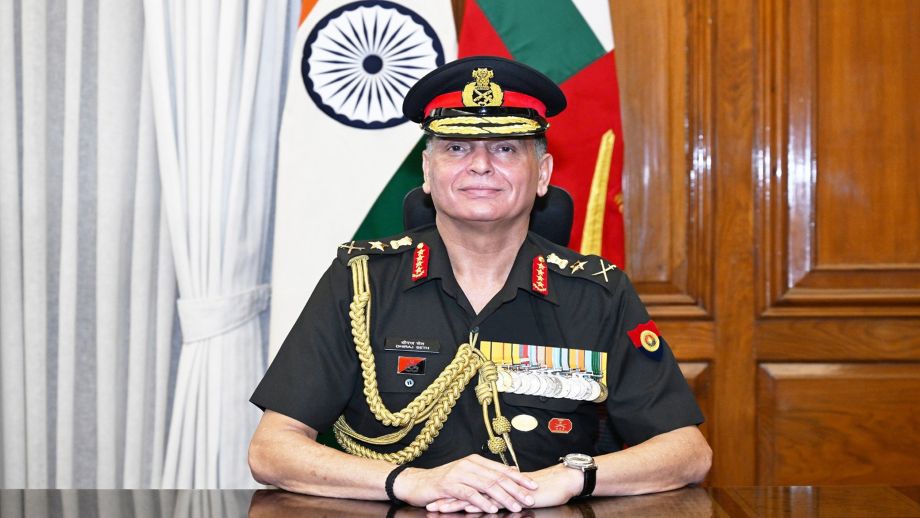
The Indian Army Chief visited key military formations under Eastern Command, including formations stationed at the strategic Siliguri Corridor, to review operational readiness and infrastructure development in one of India’s most critical defence zones.
The Siliguri Corridor, often called India’s Chicken’s Neck, is a narrow strip of land less than 20 kilometres wide at its narrowest point. It separates Nepal from Bangladesh and serves as the only road and rail link connecting mainland India to the eight northeastern states: Assam, Arunachal Pradesh, Manipur, Meghalaya, Mizoram, Nagaland, Sikkim, and Tripura.
The Army confirmed that the Chief of Army Staff was briefed on prevailing security dynamics, operational deployments, and surveillance architecture across the Eastern Command’s area of operations. The visit also included an inspection of the Nagaland-based 3 Corps, where discussions centred on inter-agency coordination and combat readiness enhancement.
This geographical vulnerability has long been recognised as a critical strategic concern. Severing the Siliguri Corridor would effectively isolate the entire northeastern region from the rest of India. China has historically identified this choke point as a potential leverage zone, and Pakistan’s strategic interests have similarly focused on regional destabilisation through this corridor.
To fortify the region, the government is executing a multi-layered infrastructure upgrade. The Railways announced plans for a 35-kilometre underground line designed to ensure military and civilian supply continuity during conflict or sabotage scenarios. The West Bengal government has transferred seven national highway stretches to central agencies including NHAI and NHIDCL for accelerated expansion and improved connectivity.
Over 120 acres of land have been transferred to the Border Security Force and other central agencies to enhance surveillance capabilities and facilitate smoother troop movements across the corridor. These infrastructure investments directly address the strategic vulnerability of the narrow passage and improve India’s ability to rapidly reinforce northeastern states during contingencies.
The region’s air defence posture has been strengthened significantly. Bagdogra Airport and Hasimara Air Force Station serve as critical logistics and defence hubs. Notably, Hasimara houses the Indian Air Force’s 101 Squadron, one of only two operational Rafale fighter squadrons in the IAF inventory. The presence of this advanced multirole combat aircraft capability in the eastern theatre enhances rapid response and air superiority options across the sensitive northeastern region.
During the visit, the Army Chief articulated his vision framework termed VIJAY, encompassing Vigilance, Innovation, Jointness, Atmanirbharta (Self-reliance), and Yodha First (Warrior First). He emphasised that anchoring the force to these principles ensures the Indian Army remains agile, adaptive, and future-ready across all operational domains.
The focus on the Siliguri Corridor reflects India’s broader strategic calculus in the northeast, where infrastructure redundancy, surveillance depth, and rapid mobilisation capability have become non-negotiable elements of national security planning.