

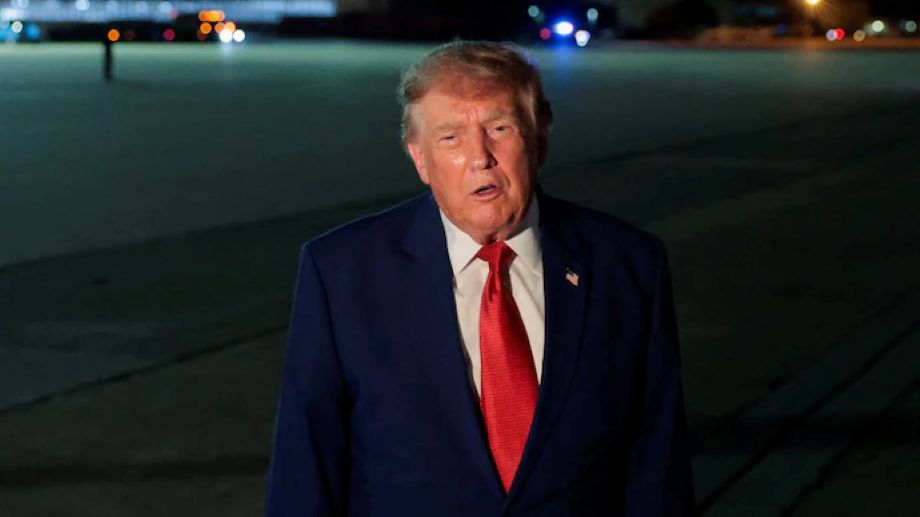
US President Donald Trump has welcomed the newly signed defence agreement between Saudi Arabia, Türkiye and Pakistan, describing the trilateral arrangement as a major step toward strengthening the countries’ ability to protect themselves and coordinate on regional security.
The agreement, known as the Mecca Joint Defence Agreement, brings together three strategically important countries and establishes a framework for closer military and security cooperation. Trump said he was pleased to see the agreement signed and characterised it as a “big, bold and important first step” toward the three nations defending themselves in a more meaningful way.
The pact was signed amid heightened security concerns across the Middle East and wider regional tensions. Under its collective-defence provision, an armed attack against any one of the three participating countries is to be treated as an attack against all three. The arrangement has therefore drawn comparisons with the collective-security principle associated with NATO, although the agreement remains a separate regional framework.
The agreement is also expected to expand practical military cooperation between Saudi Arabia, Türkiye and Pakistan. The framework includes closer coordination between political and military leadership, along with plans for joint exercises covering land, maritime, air and cyber operations.
Advanced defence areas such as unmanned systems, electronic warfare and artificial intelligence are also part of the broader cooperation agenda. The three countries have additionally indicated an interest in defence-industrial collaboration, including joint development, production and technology transfer.
For Türkiye and Pakistan, the agreement builds on an already expanding defence relationship. Ankara has developed extensive military-industrial ties with Islamabad, including cooperation in naval platforms, aviation and unmanned systems. Saudi Arabia, meanwhile, has maintained longstanding military and security links with Pakistan.
The inclusion of Türkiye gives the new arrangement an additional strategic dimension. Türkiye possesses one of NATO’s largest armed forces and has increasingly pursued an independent defence-industrial capability, while Pakistan brings substantial military experience and established defence cooperation with both Saudi Arabia and Türkiye.
The pact comes at a time when regional countries are reassessing their security arrangements amid growing tensions involving Iran and other Middle Eastern flashpoints. Reuters reported that the agreement is intended to strengthen regional defence coordination while remaining separate from existing alliances. Türkiye has also indicated that the framework could potentially be expanded in the future.
Trump’s positive reaction is significant because all three countries maintain important relationships with Washington, even as they pursue greater regional security cooperation. His endorsement suggests that the United States views the emerging arrangement as a potentially constructive development rather than an immediate challenge to existing security structures.
For India, the new trilateral defence framework will also be closely watched. Pakistan’s participation, combined with its growing defence relationship with Türkiye, gives the agreement a relevance beyond the Middle East. Türkiye and Pakistan have increasingly cooperated on military technology and defence projects, while Türkiye has also taken positions on issues important to India.
At this stage, the practical military impact of the Mecca Joint Defence Agreement will depend on how quickly its proposed mechanisms are implemented. Joint exercises, intelligence coordination, defence production and interoperability between the three armed forces could determine whether the pact develops into a substantial security mechanism or remains primarily a strategic political framework.
Nevertheless, the agreement marks a notable development in the regional security landscape. With Saudi Arabia, Türkiye and Pakistan committing to closer collective defence cooperation, the pact could contribute to a broader reshaping of military partnerships across the Middle East and surrounding regions.