

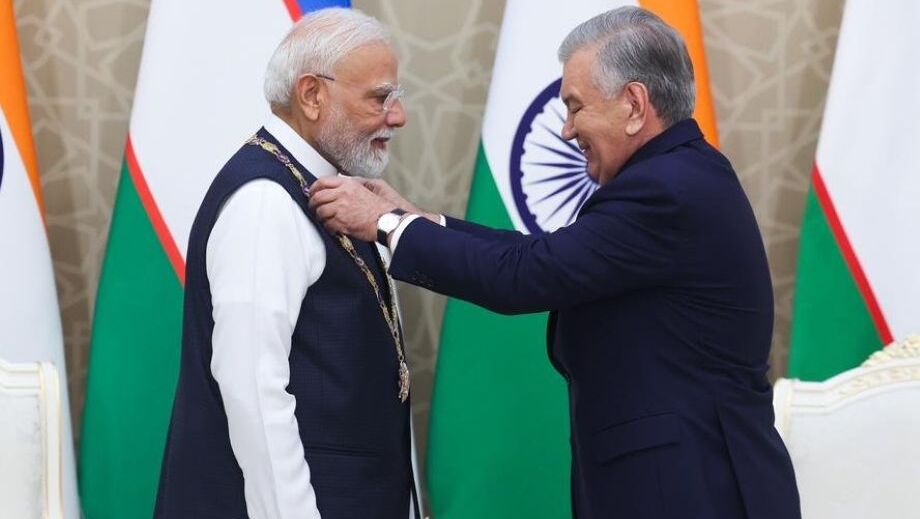
Prime Minister Narendra Modi has been conferred Uzbekistan’s highest state honour for foreign leaders, the Order of “Oliy Darajali Do’stlik” or Order of Highest Friendship, by Uzbek President Shavkat Mirziyoyev during his two-day State Visit to Tashkent on August 30, 2026. The prestigious recognition was presented in acknowledgment of Modi’s contribution to strengthening friendship and bilateral relations between India and Uzbekistan.
Accepting the honour, Prime Minister Modi dedicated the award to the 1.4 billion people of India and described it as a symbol of the enduring friendship between the two countries and their civilisations. He also highlighted the centuries-old cultural and historical links between India and Uzbekistan, while stressing that the recognition brings an added responsibility for the two nations to work together for the benefit of the Global South and humanity.
The honour came against the backdrop of a significant strengthening of India-Uzbekistan relations. During Modi’s visit, the two sides agreed to elevate their relationship to a Comprehensive Strategic Partnership, opening the way for closer cooperation across several areas, including trade, investment, defence, energy, technology and digital connectivity. The development reflects the broader effort by New Delhi and Tashkent to expand their relationship beyond traditional political and economic engagement.
Defence and security cooperation are expected to remain an important part of the evolving partnership. India and Uzbekistan have been working to expand strategic engagement in Central Asia, with greater coordination contributing to regional stability and connectivity. The broader strategic framework agreed during the visit provides additional scope for cooperation in areas linked to defence, security and emerging technologies.
Energy cooperation also emerged as a major outcome of the visit. India and Uzbekistan moved towards establishing a long-term uranium supply arrangement, adding an important strategic dimension to bilateral relations. For India, deeper cooperation with Uzbekistan in the energy sector can contribute to long-term energy security and diversify strategic resource partnerships.
The two countries also formalised three sister-city and sister-state partnerships to strengthen cooperation at the regional and local levels. Discussions further highlighted the potential for exchanges linked to urban development, digitalisation and technology, with both sides seeking to share experiences from major development initiatives.
President Mirziyoyev praised India’s economic and technological progress, including developments in digitalisation, artificial intelligence, information technology and space exploration. He also emphasised Uzbekistan’s interest in expanding cooperation with India as relations continue to move towards a more comprehensive strategic framework.
Prime Minister Modi’s visit therefore carried significance beyond the conferment of Uzbekistan’s highest state honour. It highlighted the steady transformation of India-Uzbekistan ties into a broader strategic partnership covering defence, energy, commerce, technology and people-to-people engagement.
With both sides committing to work together as partners in the Global South, the latest developments indicate that New Delhi and Tashkent are seeking a deeper and more wide-ranging relationship at a time when Central Asia is gaining greater strategic importance.