


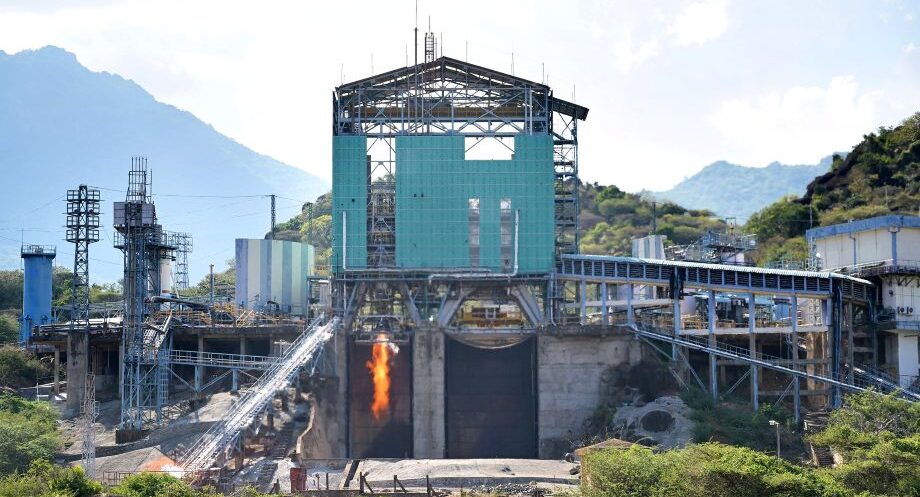
The Indian Space Research Organisation (ISRO) has successfully completed the flight-acceptance hot test of a CE20 cryogenic engine earmarked for the upcoming seventh operational mission of the Launch Vehicle Mark-3 (LVM3-M7), marking another important step in strengthening India’s heavy-lift launch capabilities.
The test was conducted on September 9, 2026, at the Main Engine and Stage Test facility of the ISRO Propulsion Complex (IPRC) in Mahendragiri, Tamil Nadu. According to ISRO, the CE20 engine was tested at an uprated thrust level of 22 tonnes, or approximately 220 kN, as part of efforts to enhance the payload capability of the LVM3 launch vehicle.
The CE20 is the cryogenic upper-stage engine used with the LVM3’s C32 stage. For flight acceptance, cryogenic engines undergo hot testing to verify that their systems perform satisfactorily under operating conditions before being cleared for an actual mission. ISRO said the CE20 test met all its objectives and confirmed the satisfactory performance of the engine systems.
The test also demonstrated the LOX Tank Pressurization Module (LTPM) developed for the C32 stages planned for the Gaganyaan programme. The successful demonstration of the module is significant because reliable propellant management and pressurisation are essential for the operation of the launch vehicle during demanding missions, including future human spaceflight missions.
To conduct the hot test under sea-level conditions while using a nozzle designed for high-altitude operation, ISRO had earlier developed and validated a Nozzle Protection System. The system enables flight-acceptance testing of the cryogenic upper-stage engine while simulating flight-equivalent conditions.
Following the successful test, the CE20 engine will be refurbished and assembled with the C32 flight stage for the LVM3-M7 mission. ISRO has scheduled the mission for the fourth quarter of 2026.
The successful 22-tonne-thrust test represents an important propulsion milestone for the LVM3 programme. Increasing the thrust capability of the cryogenic upper stage is expected to support higher payload capacity, while the validation of systems such as the LTPM contributes to the continued development of launch vehicle technologies required for India’s future space missions and the Gaganyaan human spaceflight programme.