


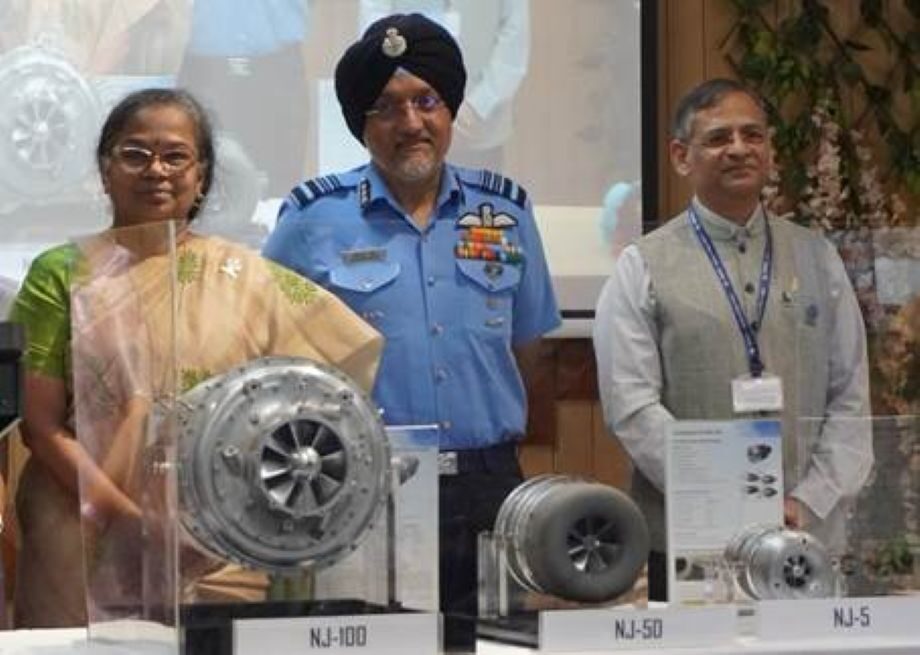
India has taken a significant step towards strengthening its indigenous aerospace propulsion capabilities with the unveiling of three micro and small gas turbine engines developed by the CSIR-National Aerospace Laboratories (CSIR-NAL). The NJ-05, NJ-50 and NJ-100 engines were unveiled on August 25, 2026, at the CSIR Headquarters in New Delhi, marking an important development for India’s unmanned defence and aerospace ecosystem.
The three propulsion systems have been developed with different thrust capacities to address a range of requirements. The NJ-05 delivers 5 kg of thrust, the NJ-50 provides 50 kg of thrust, while the NJ-100 offers 100 kg of thrust. According to the Ministry of Science and Technology, the engines are intended for applications including tactical unmanned aerial vehicles (UAVs), drone interceptors and compact missile systems.
The unveiling was attended by senior figures from India’s defence and scientific communities, with Air Marshal Tejinder Singh, Chief of Integrated Defence Staff to the Chairman Chiefs of Staff Committee, serving as the chief guest. The development highlights the strategic importance of building domestic expertise in specialised propulsion technologies that are critical to modern unmanned and aerospace platforms.
A key aspect of the programme is the technology developed by CSIR-NAL in high-RPM turbomachinery and high-temperature combustion. These capabilities are central to producing compact gas turbine propulsion systems and could help create a stronger domestic technology base for future unmanned defence platforms.
CSIR-NAL Director Abhay A. Pashilkar highlighted the laboratory’s evolving role in supporting India’s rapidly expanding drone ecosystem. He also noted the potential for Indian industry, including the country’s growing aerospace start-up se Air Marshal Tejinder Singh ctor, to manufacture such engines at scale for domestic defence requirements.
The development of the NJ-05, NJ-50 and NJ-100 is significant because propulsion remains one of the critical technologies required for advanced unmanned systems. Establishing indigenous capabilities in compact gas turbine engines can reduce reliance on foreign propulsion technologies while giving Indian defence manufacturers and start-ups greater opportunities to develop and scale locally designed platforms.
The new engines are also expected to contribute to the creation of a wider ecosystem for designing, developing and manufacturing miniaturised gas turbine propulsion systems in India. With the country’s UAV and drone sector expanding, domestically developed propulsion technologies could support the development of a broader range of tactical unmanned platforms and compact defence systems.
The unveiling of the NJ-05, NJ-50 and NJ-100 therefore represents more than the introduction of three new engines. It reflects India’s broader push to build critical aerospace technologies within the country and strengthen the industrial foundation required for next-generation UAVs, drone interceptors and other unmanned defence platforms.