


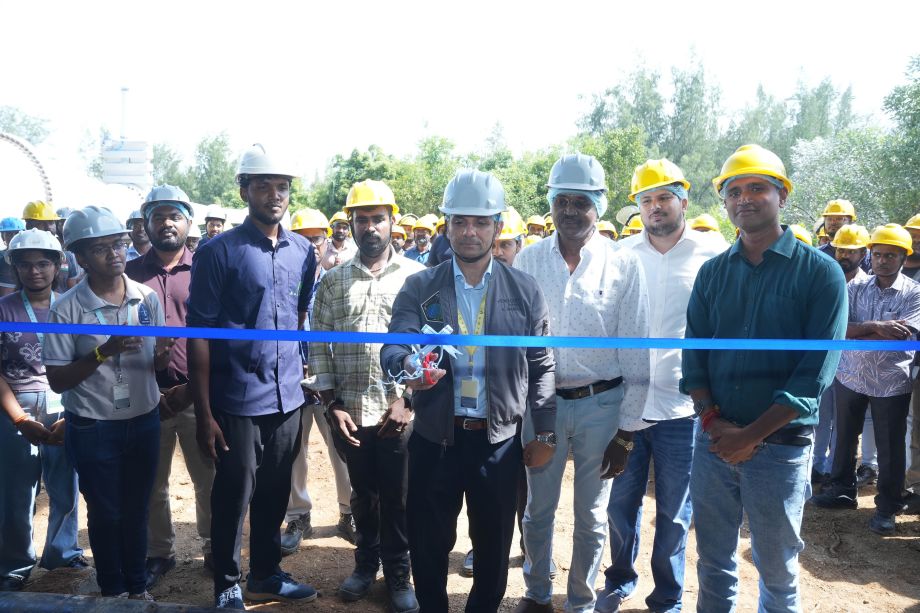
Indian private space company Agnikul Cosmos has expanded its infrastructure in Chennai with the inauguration of two specialised facilities aimed at advancing reusable rocket technology and strengthening its ability to develop and manufacture launch vehicle systems in-house.
The Chennai-based startup inaugurated the Stage Testing & Inspection Facility (STIF) and the Pressurant Tank Realisation, Over-wrapping and Outfitting Facility (PROOF) at its assembly and testing facility. The new infrastructure is intended to support the company’s efforts to develop reusable rocket stages and prepare for its upcoming Mission-02. The facilities were inaugurated in the presence of Group Captain Shubhanshu Shukla, the Indian astronaut associated with the Gaganyaan programme.
The STIF is designed to allow Agnikul to test complete reusable rocket stages under conditions that replicate flight operations. The facility can support thrust levels ranging from 1 kN to 200 kN, LOX sub-cooling down to 73 K and full-duration burns of up to 150 seconds. It will also enable the company to inspect and requalify rocket stages recovered after flight, an important capability for developing a reusable launch system.
The second facility, PROOF, focuses on the in-house production of pressurant tanks and other pressure vessels used in launch vehicles. According to the company, the facility can manufacture more than 10 vessels per month, including vessels with capacities of up to 3,500 litres and pressure ratings of up to 350 bar. This capability is expected to improve Agnikul’s control over the production of critical launch vehicle components.
Reusable launch technology is becoming an increasingly important area in the global space industry because the ability to recover and fly rocket stages again can potentially reduce launch costs and improve the frequency of missions. Agnikul’s new infrastructure is aimed at developing the testing, inspection and manufacturing capabilities required to move toward this model.
The company has already developed significant in-house capabilities. Agnikul designs and manufactures its single-piece, 3D-printed semi-cryogenic engines and also develops avionics and propulsion systems for its launch vehicles. Its Agnibaan family is designed as a configurable small-lift launch vehicle platform for dedicated satellite missions.
Agnikul previously conducted its first mission, Agnibaan SOrTeD, in May 2024 from its privately developed launchpad at Sriharikota. The mission marked an important milestone for India’s private space sector and demonstrated the growing capabilities of domestic commercial launch companies.
The latest expansion comes as India’s private space ecosystem continues to grow rapidly. Indian space startups are increasingly moving beyond early-stage technology development into launch vehicles, satellite manufacturing, propulsion, Earth observation and other commercial space applications.
For Agnikul, the new Chennai facilities represent more than an expansion of manufacturing infrastructure. They provide the company with greater control over testing, recovery, inspection and production processes that will be essential if reusable launch vehicles are to become a practical part of its future operations.
With Mission-02 ahead, Agnikul Cosmos is now building the infrastructure needed to take its reusable rocket ambitions to the next stage. The development also highlights the growing role of Indian private companies in expanding the country’s indigenous launch capabilities and strengthening India’s position in the global commercial space market.