


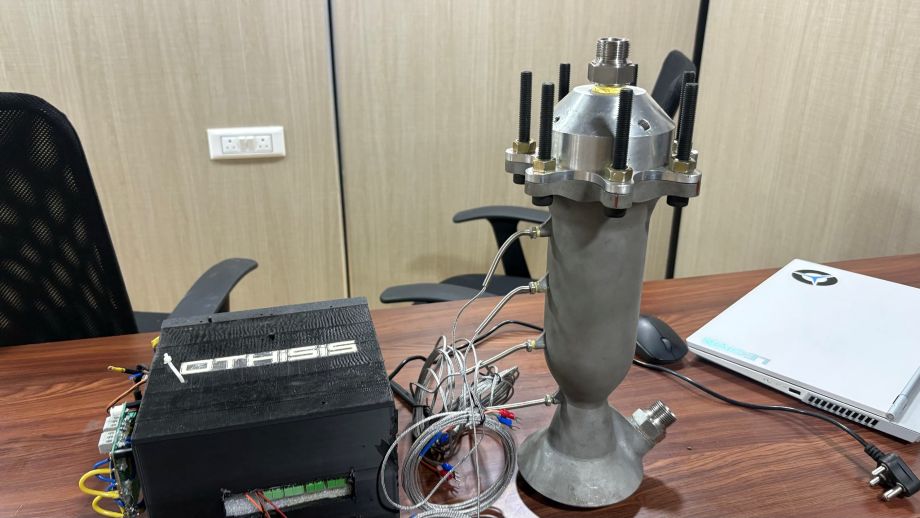
Bangalore-based space start-up Othisis has achieved a significant milestone in India’s emerging private space sector by successfully hot-firing its regeneratively cooled, fully cryogenic 3D-printed rocket engine. The engine produced a nominal thrust of 5 kN during testing and is being developed as part of the company’s broader programme for reusable launch vehicles.
The engine uses liquid oxygen and methane as propellants, a combination increasingly being explored for reusable rocket systems because of its relatively clean combustion characteristics and suitability for repeated operations. Othisis has incorporated regenerative cooling into the engine, with propellant flowing through channels around the combustion chamber to absorb heat and protect the engine structure during firing.
A major feature of the system is its 3D-printed construction. Othisis manufactured the engine at its Whitefield facility in Bangalore, using additive manufacturing to integrate complex cooling channels directly into the chamber walls. This approach can reduce component count and assembly requirements while allowing more sophisticated internal geometries than conventional manufacturing methods.
The engine also uses a modular pintle injector architecture, allowing the thrust configuration to be modified through changes to the injector component. During the reported hot-fire campaign, the engine achieved approximately 5 kN of thrust at a chamber pressure of 35 bar, with a reported total impulse of 100 kN·s. The company conducted more than 20 test cycles, including three unsuccessful ignition attempts, before achieving a sustained successful burn.
Othisis also developed its own test infrastructure, including the propellant feed system, cryogenic-rated valves and custom electronics. The company carried out water-flow and cold-flow testing before proceeding to live engine firings, helping validate the propulsion and test systems ahead of the hot-fire campaign.
The propulsion system is intended to support Othisis’s reusable vertical take-off and landing rocket programme. The company is targeting domestic launch opportunities for small and medium-sized satellite customers, with reusable architecture potentially enabling more frequent missions and lower launch costs over time.
The successful engine demonstration comes as India’s private space ecosystem continues to expand beyond satellite manufacturing into launch vehicles, propulsion and other advanced technologies. Companies including Skyroot Aerospace, Agnikul Cosmos and Bellatrix Aerospace have already been developing indigenous launch and propulsion technologies, contributing to the growth of a broader commercial space industry.
For Othisis, the next major milestone is expected to be the flight demonstration of its reusable hopper vehicle. A successful flight test would provide an important validation of the company’s propulsion and reusable-launch approach and could support future development toward larger orbital-class launch vehicles.
The achievement highlights the growing ability of Indian start-ups to develop sophisticated propulsion technologies domestically. If Othisis can successfully progress from ground-based hot-fire testing to repeated flight operations, its technology could become part of India’s expanding effort to build a competitive and increasingly self-reliant commercial space-launch ecosystem.