


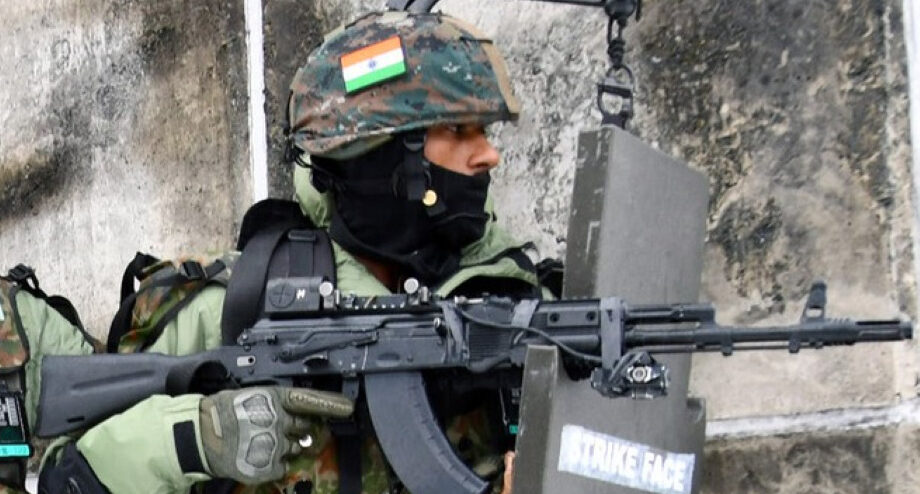
The Indian Army’s standard infantry rifle has undergone a major transformation since Independence, evolving in response to changing combat conditions, technological advances and the growing need for reliable small arms. From the bolt-action Lee-Enfield inherited from the British era to the modern AK-203, the journey reflects the Army’s broader effort to modernise its infantry weapons.
At the time of Independence, the Lee-Enfield remained one of the principal rifles used by Indian soldiers. Although robust and proven in combat, its bolt-action mechanism represented an earlier generation of infantry weapon technology. India subsequently moved towards locally manufactured variants, including the Ishapore 2A1, as it sought to maintain and gradually modernise its small-arms inventory.
The next major step came with the development of the Indian Small Arms System, or INSAS. Designed as an indigenous assault-rifle family, the INSAS represented an important effort to reduce dependence on foreign small arms while providing Indian troops with a modern self-loading rifle. Chambered for 5.56×45mm ammunition, the rifle became a major part of the Army’s infantry arsenal.
However, operational experience and changing requirements led to criticism of the INSAS, particularly concerning reliability and suitability for demanding combat environments. This contributed to the Army’s search for newer assault rifles capable of delivering greater reliability and effectiveness.
The Army subsequently introduced the SIG716 in 7.62×51mm as an additional modern rifle, particularly for frontline personnel. The move provided soldiers with a more powerful rifle while India continued working towards large-scale domestic production of a new standard assault rifle.
That effort eventually centred on the AK-203. The rifle is being produced in India by Indo-Russian Rifles Private Limited (IRRPL), a joint venture involving Indian and Russian entities. The Government of India signed a contract in December 2021 for 6,01,427 AK-203 assault rifles, with production planned at Korwa in Uttar Pradesh.
The AK-203 uses the 7.62×39mm cartridge and has an effective range of around 300 metres. Its design draws on the established Kalashnikov family while incorporating modern features intended to improve handling, reliability and adaptability for contemporary infantry operations. The rifle is also intended to replace the INSAS in the Army’s gradual small-arms modernisation programme.
The Korwa production programme is also significant from an industrial perspective. According to the Ministry of Defence, IRRPL established facilities for indigenous AK-203 production, with the project aimed at increasing self-reliance in assault rifles under the broader Atmanirbhar Bharat initiative.
The evolution from Lee-Enfield to INSAS, SIG716 and AK-203 demonstrates how the Indian Army’s infantry weapon requirements have changed over the decades. Modern soldiers require rifles that combine reliability, manageable weight, effective range and compatibility with contemporary combat environments.
The transition is therefore more than a simple replacement of one rifle by another. It represents India’s continuing effort to modernise the individual weapons carried by its soldiers while expanding domestic defence manufacturing capabilities. With AK-203 production in India, the latest phase of this rifle evolution also connects infantry modernisation with the country’s wider push for indigenous defence production.