

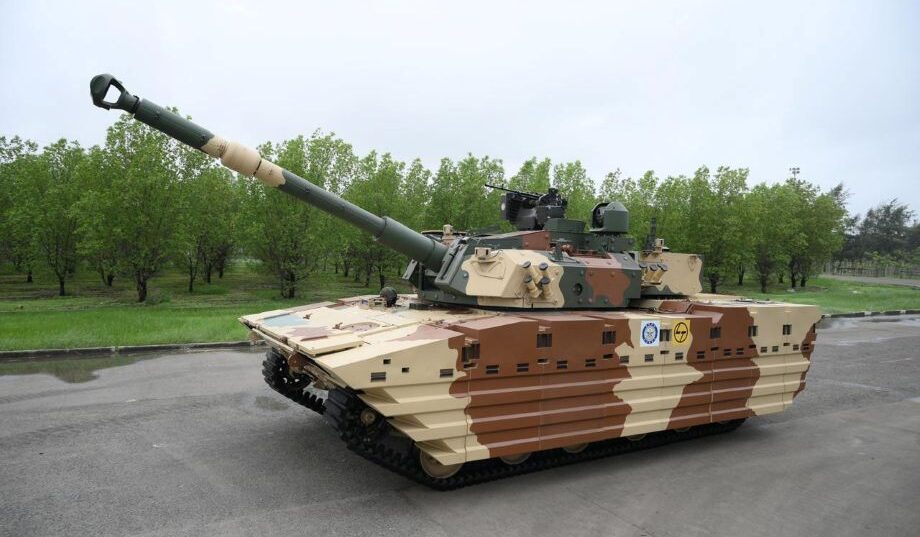
India’s indigenous Zorawar Light Tank is facing a delay of up to two years after the Indian Army sought enhanced protection against battlefield threats. The development is expected to shift the tank’s induction timeline from the earlier 2027 target to around 2028-29, subject to completion of trials, user evaluation and production readiness.
Developed jointly by the Defence Research and Development Organisation (DRDO) and Larsen & Toubro under Project Zorawar, the 25-tonne tank is being designed for operations in challenging mountainous and high-altitude areas, particularly along the Ladakh sector. The Army’s latest requirement is to improve protection beyond the existing STANAG Level 4 standard without significantly increasing the platform’s weight.
The requirement presents a technical challenge because additional armour can affect mobility, which is one of the key characteristics of a light tank intended for high-altitude warfare. Developers are therefore expected to refine protective materials and design solutions while maintaining the weight close to the 25-tonne limit.
Project Zorawar was initiated after the 2020 India-China border tensions highlighted the operational requirement for lighter armoured platforms capable of functioning in difficult terrain. The tank has already undergone trials in plains and high-altitude areas, including Ladakh.
The Indian Army has a requirement for around 354 light tanks. An initial batch of 59 is planned through the DRDO-L&T development and production effort, while procurement of the remaining platforms is expected to involve a competitive process.
The revised schedule gives developers additional time to address protection requirements and complete the necessary testing before induction. For the Army, the key challenge remains balancing survivability, mobility and high-altitude operational performance within the platform’s light-weight design.