


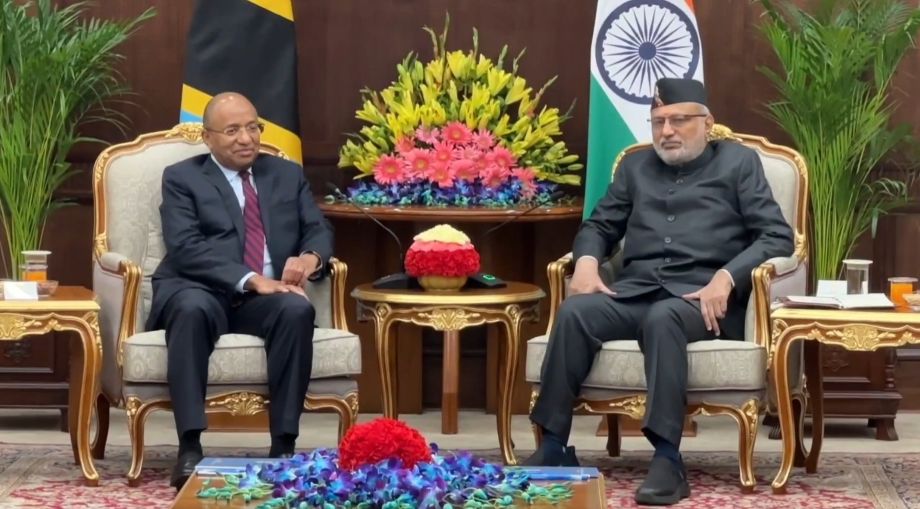
Zanzibar President Dr. Hussein Ali Mwinyi met Vice President C. P. Radhakrishnan in New Delhi today, reaffirming India’s strategic partnership with the semi-autonomous region of Tanzania and exploring expanded cooperation across trade, investment, education, and the blue economy, according to official sources.
The visit underscores India’s deepening engagement with the Global South through institutional and people-to-people channels. Zanzibar, with its own constitution, president, House of Representatives, and flag, has historically maintained distinct maritime and commercial ties with India spanning centuries, grounded in shared Indian Ocean geopolitics and cultural linkages.
President Mwinyi expressed particular appreciation for India’s support in establishing the IIT Madras Zanzibar Campus, a landmark educational initiative that reflects New Delhi’s strategy of extending higher learning institutions to strategic partners in Africa and the Indo-Pacific. The President also acknowledged India’s assistance in water infrastructure projects, scholarships under the Indian Council for Cultural Relations programme, and training under the Indian Technical and Economic Cooperation scheme.
The bilateral relationship spans defence cooperation, maritime security, and development partnership. Tanzania and Zanzibar occupy a critical position in Indian Ocean security architecture, and India has prioritised engagement with East African nations as part of its broader Indo-Pacific strategy and outreach to Global South economies.
External Affairs Minister Dr S. Jaishankar also held talks with President Mwinyi, signalling the political weight New Delhi attaches to the visit. The four-day official visit, undertaken at the Vice President’s invitation, is accompanied by Zanzibar’s spouse and a high-level delegation comprising ministers and senior officials, indicating comprehensive bilateral discussions across multiple sectors.
India and Tanzania share long-standing cooperation frameworks covering defence, maritime domain awareness, trade, and development assistance. This visit is expected to yield fresh momentum in bilateral relations across priority sectors including the blue economy, a focus area for both nations given their Indian Ocean positioning and maritime interests.
The discussion of blue economy cooperation is particularly significant given India’s growing focus on ocean governance, sustainable fisheries, marine research, and maritime infrastructure in the Indian Ocean region. Education partnerships, exemplified by the IIT Madras campus initiative, align with India’s broader vision of using knowledge institutions as soft power instruments in Africa and the Global South.