

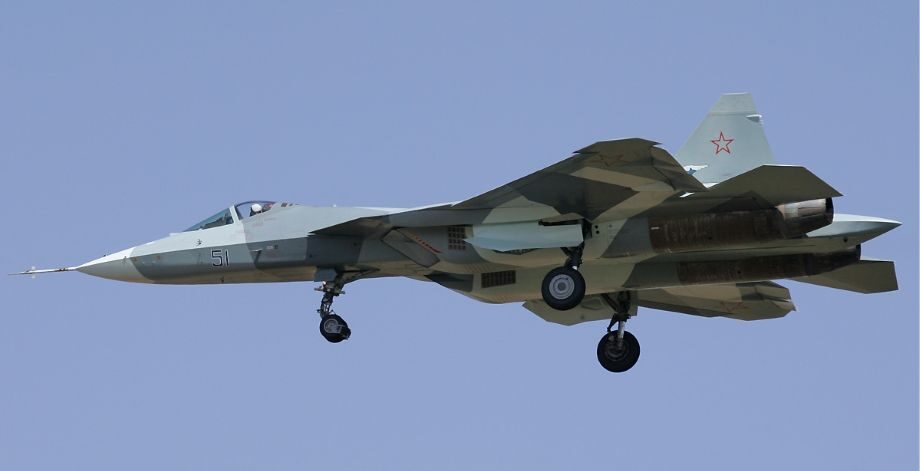
Russia is intensifying its international marketing campaign for the Su-57 fifth-generation stealth fighter as Moscow seeks to expand the aircraft’s presence in overseas defence markets. Russian officials and defence industry representatives are presenting the fighter as a capable alternative to Western and Chinese fifth-generation aircraft, while recent export activity has increased attention on the Su-57E variant.
United Aircraft Corporation CEO Vadim Badekha has highlighted the Su-57’s operational experience, arguing that the aircraft has demonstrated its capabilities in real combat conditions. Russian defence officials have also pointed to its ability to operate with a wide range of air-launched weapons and to engage targets in heavily contested environments. These claims form a major part of Moscow’s current effort to strengthen the aircraft’s position in the global fighter market.
The export campaign gained further momentum this month with Russia showcasing the Su-57E at the El Alamein International Airshow in Egypt. Rostec said the export version would be displayed with new weapons, highlighting the aircraft and its associated systems to potential international customers. The appearance marked an important step in Russia’s effort to promote the Su-57 in African and Middle Eastern defence markets.
Russia has also indicated that international interest in the aircraft is growing. Rosoboronexport has announced additional export contracts for the Su-57, although the identities of some customers and the number of aircraft involved have not been publicly disclosed. Algeria has emerged as an identified foreign operator, while reports have linked additional potential orders to countries in the Middle East and Central Asia.
The Su-57 is being marketed on the basis of a combination of speed, range, manoeuvrability and weapons-carrying capability. The fighter has a reported combat radius of around 1,500 kilometres and a maximum speed of approximately Mach 2. Russia is also emphasising its ability to integrate different missile types, giving the aircraft a broad multirole capability.
However, the aircraft continues to face competition from the US F-35 and China’s J-20. Analysts have questioned some of Moscow’s claims regarding the Su-57’s overall superiority, particularly in areas such as stealth, avionics and network-centric warfare. The F-35 benefits from extensive operational experience and a large international user base, while China’s J-20 has emerged as a major component of Beijing’s air-power modernisation.
Production scale is another factor influencing the Su-57’s competitiveness. The number of aircraft produced remains considerably smaller than the global fleets of the F-35 and J-20. This could affect Russia’s ability to meet large export orders quickly, particularly as potential customers increasingly evaluate delivery timelines, long-term support and upgrade requirements alongside aircraft performance.
For India, the renewed Russian push is particularly significant because Moscow has previously promoted the Su-57 as a possible option for strengthening the Indian Air Force’s future fifth-generation fighter capability. However, India is simultaneously advancing its indigenous Advanced Medium Combat Aircraft programme and has previously indicated that it is not pursuing a new Sukhoi fighter variant in the near term.
Russia’s latest campaign therefore goes beyond promoting a single fighter aircraft. By taking the Su-57E to international airshows and highlighting its combat experience and weapons integration, Moscow is attempting to establish the aircraft as a viable export platform at a time when demand for advanced fighter technology is increasing.
The coming months will show whether Russia can convert the renewed international attention into additional confirmed Su-57E contracts and establish the aircraft as a more significant player in the global fifth-generation fighter market.