

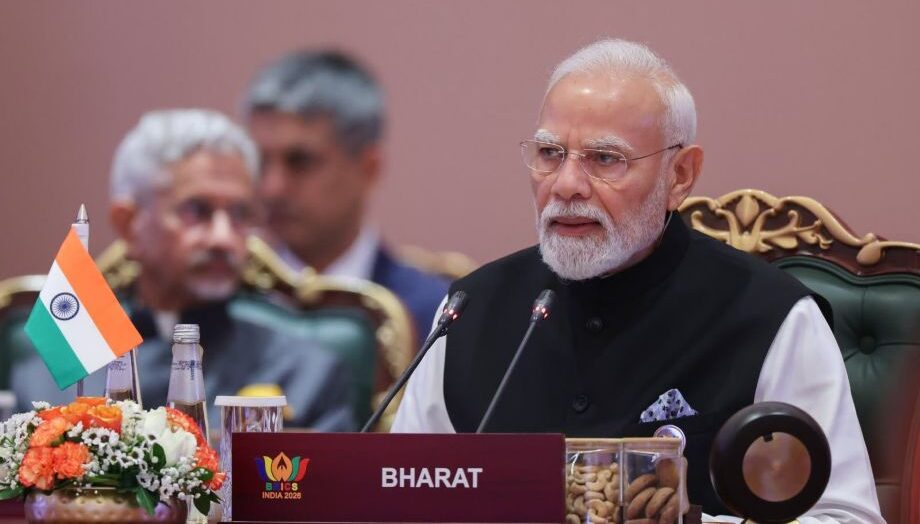
Prime Minister Narendra Modi concluded an intensive three-day diplomatic engagement on the sidelines of the 18th BRICS Summit in New Delhi, holding 15 formal bilateral meetings with heads of state and government as India hosted the major grouping of emerging economies. The engagements, held alongside the BRICS summit agenda, covered a wide range of strategic and economic issues involving Russia, China, Iran, Africa, Southeast Asia, Central Asia and the Gulf.
Among the most closely watched meetings were Modi’s discussions with Russian President Vladimir Putin, Chinese President Xi Jinping and Iranian President Masoud Pezeshkian. The talks addressed bilateral relations, regional conflicts, border stability, maritime security, defence cooperation and broader priorities of the Global South. The diplomatic push highlighted New Delhi’s effort to maintain engagement with major powers while advancing its priorities during India’s BRICS chairship.
Modi’s meeting with Putin on September 11 focused on the India-Russia strategic partnership across political, economic, defence, energy, space and other areas. The two leaders also discussed developments in West Asia and the Black Sea region, including their impact on maritime trade and the safety of Indian seafarers. Putin invited Modi to Russia for the 24th India-Russia Annual Summit, an invitation the Indian Prime Minister accepted.
India-China relations were another important component of the diplomatic marathon. During his September 12 meeting with Xi Jinping, Modi highlighted the importance of maintaining peace and tranquillity along the border and urged both sides to build relations around mutual respect, mutual sensitivity and mutual interest. The two leaders also discussed trade, supply chains, market access, people-to-people relations and efforts to prevent bilateral differences from developing into disputes.
Modi also met Iranian President Masoud Pezeshkian and discussed bilateral ties as well as developments in West Asia. India reiterated its position that regional issues should be addressed through dialogue and diplomacy, while also stressing the importance of freedom of navigation, uninterrupted commerce and the safety of seafarers.
The Prime Minister’s wider engagements extended across Africa and the Global South. Meetings with leaders from Burundi, South Africa, Nigeria, Uganda and Ethiopia covered areas including trade, investment, defence and security, technology, energy, agriculture and capacity building. With Nigerian Vice President Kashim Shettima, discussions included strengthening the India-Nigeria strategic partnership, while the India-Africa partnership was described as an important pillar of cooperation within the Global South.
In Southeast Asia and the Gulf, Modi discussed defence, security, technology, infrastructure, energy and investment with leaders including Philippine President Ferdinand Marcos Jr., Malaysian Prime Minister Anwar Ibrahim, Vietnamese Prime Minister Le Minh Hung and UAE Crown Prince Sheikh Khaled bin Mohamed. The India-UAE discussions also covered strategic areas such as defence, space, nuclear energy and emerging technologies.
Alongside the bilateral meetings, Modi chaired a BRICS session focused on resilience, innovation, cooperation and sustainability. India highlighted initiatives involving infectious-disease early warning, disaster-management data, logistics and supply-chain cooperation, start-up innovation, digital agriculture and the wider use of technology for inclusive growth.
The diplomatic marathon also included a meeting with UN Secretary-General António Guterres, during which the two sides discussed multipolarity, reform of multilateral institutions, conflicts, freedom of navigation, sustainable development, artificial intelligence and global food security. The engagements came as BRICS leaders adopted the New Delhi BRICS Leaders’ Declaration, which expressed concern over escalating tensions in West Asia and called for restraint.
The scale of Modi’s three-day diplomatic schedule underlines India’s effort to use its BRICS chairship to strengthen strategic partnerships across multiple regions while keeping defence, economic cooperation, connectivity, maritime security and Global South priorities at the centre of its international engagement. Recent reporting also confirms that Modi held 15 formal bilateral meetings during the summit period, alongside several informal interactions with visiting leaders and international institutions.