


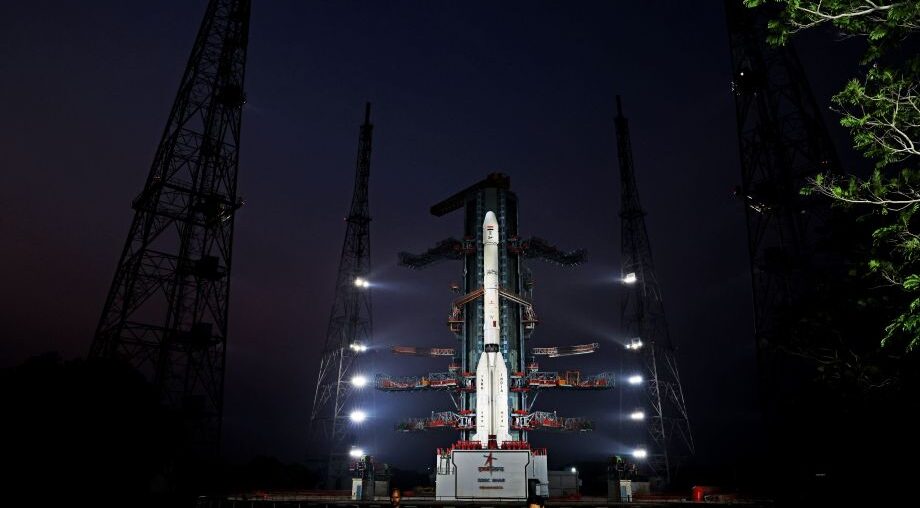
The Indian Space Research Organisation (ISRO) has successfully completed the first orbit-raising manoeuvre of its NVS-03 navigation satellite, marking significant progress in India’s efforts to strengthen its indigenous satellite navigation infrastructure. The operation, conducted on October 31, 2026, has moved the spacecraft closer to its designated orbital position as part of the ongoing deployment process for the Navigation with Indian Constellation (NavIC).
NVS-03 was launched aboard the Geosynchronous Satellite Launch Vehicle (GSLV-F18) from the Satish Dhawan Space Centre in Sriharikota on October 30, 2026, at 11:51 pm IST. Following its launch, the rocket successfully injected the satellite into an initial Geosynchronous Transfer Orbit (GTO) measuring approximately 170.3 km by 38,080 km.
According to ISRO, the first planned orbit-raising operation was completed at 4:48 pm IST on October 31. During the manoeuvre, the satellite’s onboard Liquid Apogee Motor (LAM) operated continuously for 2,174.8 seconds, or approximately 36 minutes. The operation raised the spacecraft’s perigee, changing its estimated orbital parameters to approximately 5,477.6 km by 37,833.4 km. ISRO also confirmed that the satellite remained in normal health following the manoeuvre.
The spacecraft will undergo additional orbit-raising operations in the coming days to gradually reach its designated geosynchronous orbit at 111.75 degrees East longitude. These manoeuvres are essential for bringing the satellite into its intended operational position and completing the deployment process.
NVS-03 is the third spacecraft in India’s second-generation navigation satellite series, comprising five planned satellites from NVS-01 to NVS-05. The programme aims to improve the availability, reliability and continuity of NavIC services, India’s independent regional satellite navigation system developed by ISRO.
The satellite incorporates several important technological improvements intended to strengthen the performance and compatibility of the navigation network. It carries navigation payloads operating in the L1, L5 and S frequency bands. The addition of the L1 signal alongside the existing L5 and S-band signals is expected to improve compatibility with a wider range of navigation receivers and applications.
Another important feature of NVS-03 is its indigenous atomic clock, which operates alongside procured atomic clocks. Highly accurate timing is fundamental to satellite navigation, as receivers calculate their positions using the precise time taken by signals to travel from satellites to Earth.
NavIC provides positioning, navigation and timing services across the Indian landmass and a surrounding region extending approximately 1,500 kilometres beyond India’s geopolitical boundaries. Its applications include civilian transportation, maritime navigation, aviation, precision agriculture, disaster management and strategic operations.
The progress of NVS-03 is particularly important for the continuity of India’s regional navigation services following the difficulties encountered during the NVS-02 mission. Launched in January 2025, NVS-02 could not complete its planned orbit-raising operations because of a problem involving the spacecraft’s propulsion system, preventing it from reaching its designated orbital position.
With the successful completion of its first orbit manoeuvre, NVS-03 has cleared an important stage of its deployment. The remaining orbital operations will determine its final positioning before it can contribute to the NavIC constellation.
The mission represents another step in India’s efforts to strengthen technological self-reliance in satellite navigation and reduce dependence on foreign positioning systems for critical applications. Once fully deployed and operational, NVS-03 is expected to reinforce India’s independent positioning, navigation and timing capabilities for both civilian and strategic requirements.