


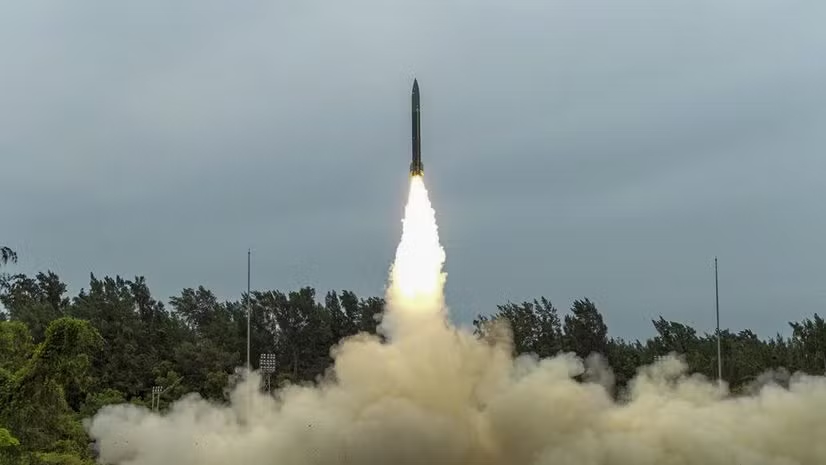
India is moving closer to operationalising its next-generation hypersonic strike capability, as the Defence Research and Development Organisation (DRDO) advances trials of the Long-Range Anti-Ship Missile (LR-AShM), a cutting-edge weapon designed to significantly enhance maritime dominance.
The LR-AShM, a boost-glide hypersonic missile currently under development, is engineered to deliver high-speed precision strikes against both static and moving naval targets. With trials approaching, defence officials have outlined its core capabilities, positioning the system as a key pillar in India’s evolving strategic deterrence architecture.
Advanced Hypersonic Capabilities
The missile operates at hypersonic speeds-exceeding Mach 5-making it extremely difficult for existing air defence systems to detect or intercept. Its glide vehicle design allows it to maneuver unpredictably during the terminal phase, further enhancing survivability in contested environments.
In addition, the LR-AShM is expected to integrate advanced indigenous avionics and high-precision sensor systems, ensuring accurate targeting across long distances. The platform is also designed to carry multiple payload configurations, allowing flexibility across mission profiles.
Strategic Role in Maritime Defence
Primarily developed for the Indian Navy, the missile is intended to be deployed via shore-based transporter erector launchers, strengthening coastal defence infrastructure and expanding sea-denial capabilities.
With an estimated strike range of up to 1,500 km, the LR-AShM will enable India to engage high-value enemy assets far beyond immediate littoral zones, reinforcing its position in the Indo-Pacific security landscape.
Boost to Indigenous Defence Ecosystem
The development of LR-AShM aligns with India’s broader push for self-reliance in defence manufacturing and advanced weapon systems. The missile was publicly showcased during the Republic Day parade earlier this year, signalling its transition from conceptual development to advanced testing stages.
Parallel advancements, including successful scramjet engine tests, are further strengthening India’s hypersonic technology base, which is critical for sustaining high-speed missile operations over extended ranges.
As global military powers accelerate investments in hypersonic weapons, India’s LR-AShM program reflects a calibrated approach to maintaining credible deterrence and operational superiority at sea. The upcoming trial phase will be crucial in validating performance parameters and paving the way for eventual induction into service.