

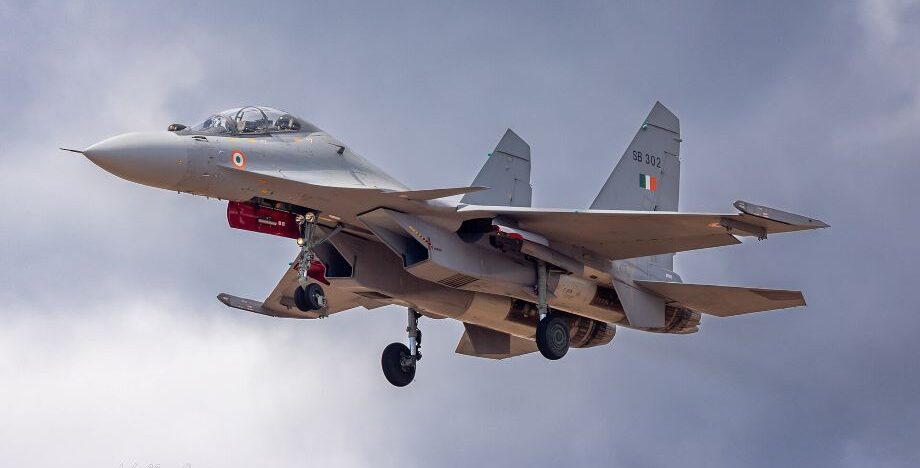
India is moving ahead with plans to strengthen the operational capability of its Sukhoi Su-30MKI fighter fleet through a combination of airframe overhauls, systems modernisation and new long-range missile capabilities. The latest proposals underline the Indian Air Force’s focus on keeping its largest fighter fleet combat-ready while gradually introducing more advanced weapons and indigenous technologies.
A key proposal under consideration involves the overhaul of 40 Su-30MKI fighter aircraft. Hindustan Aeronautics Limited (HAL) has put forward the plan, which requires approval from the Defence Acquisition Council (DAC) because of the financial scale involved. The proposed work is aimed primarily at restoring and extending the operational life of aircraft that have accumulated significant flying hours.
The move is particularly important because the Su-30MKI remains the backbone of the Indian Air Force’s fighter fleet, with around 260 aircraft in service. Maintaining the availability of such a large fleet is critical as the IAF continues to face a shortage of operational fighter squadrons.
The overhaul proposal comes alongside a broader effort to increase the combat potential of the Su-30MKI. India is also examining the integration of the Russian-origin RVV-BD long-range air-to-air missile with the fighter. The missile is designed to engage aerial targets at extended distances and is particularly suited to missions against high-value support aircraft such as airborne early-warning and reconnaissance platforms.
According to the latest reports, the RVV-BD can reach speeds approaching Mach 6 and has a reported engagement range of up to around 300 kilometres, depending on the launch and target conditions. If approved and successfully integrated, the weapon would give selected Su-30MKI aircraft a substantially greater reach in beyond-visual-range air combat.
The proposed missile integration is part of India’s wider effort to expand the long-range engagement capability of its fighter fleet. At the same time, the country is pursuing indigenous alternatives, including the Astra family of air-to-air missiles, while maintaining access to foreign weapons such as the European Meteor.
The Su-30MKI is also undergoing a much broader modernisation programme. The Indian Air Force and Indian defence industry are working on upgrades involving radar, electronic warfare, avionics, communications and navigation systems. Indigenous technologies are expected to play an increasing role in this transformation, reducing dependence on imported subsystems and improving the aircraft’s compatibility with India’s network-centric warfare architecture.
The aircraft’s ability to carry a wide range of Indian weapons further increases its importance. The Su-30MKI has already been integrated with systems such as the BrahMos supersonic cruise missile and other precision-strike weapons, giving the platform a significant role in long-range strike missions in addition to conventional air-superiority operations.
The latest overhaul plan should therefore be viewed separately from the larger Super Sukhoi modernisation programme. While the overhaul is primarily concerned with sustaining the airworthiness and service life of existing aircraft, the wider modernisation effort seeks to substantially improve their sensors, weapons, electronic warfare capabilities and overall combat effectiveness.
HAL is expected to remain central to this process because of its extensive experience in manufacturing, maintaining and upgrading the Su-30MKI fleet in India. The company has already produced a large number of these fighters under licence and is responsible for significant portions of their maintenance and life-cycle support.
India’s decision to invest in the existing Su-30MKI fleet reflects the aircraft’s continuing importance to the IAF. New fighter programmes will eventually strengthen the overall fleet, but maintaining the availability and effectiveness of the Su-30MKI provides an immediate way to preserve combat strength while newer platforms and indigenous fighter programmes mature.
If the proposed overhaul and missile integration initiatives receive the necessary approvals, they could give the Su-30MKI a longer operational life while significantly expanding its role in long-range air combat. The developments also highlight India’s broader approach of combining fleet life-extension, indigenous technology and selected foreign weapon systems to maintain airpower capability during a period of rapid regional military modernisation.