

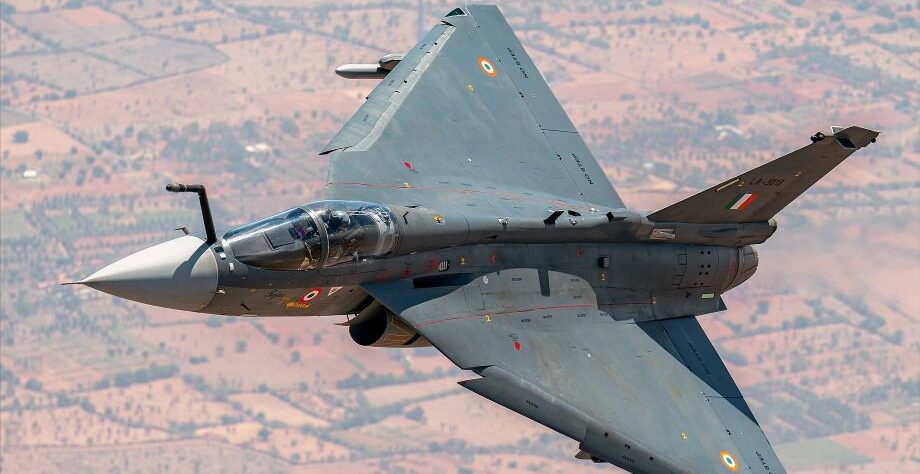
The Hindustan Aeronautics Limited (HAL) Tejas MK-1A has successfully demonstrated mid-board drop tank installations during recent flight testing, validating a critical capability that paves the way for the advanced Mark II variant to carry twin ASTRA air-to-air missile racks, according to defence sources.
The mid-board tank configuration represents an incremental but operationally significant step in expanding the single-engine fighter’s combat radius and loiter endurance without compromising its internal fuel load or structural integrity. These auxiliary fuel tanks, mounted on the fuselage sides outboard of the main landing gear sponsons, have been a long-standing requirement of the Indian Air Force to extend the Tejas platform’s operational range.
The successful integration of mid-board drop tanks on the MK-1A variant serves as a testbed and validation platform for the enhanced weapon-carriage architecture planned for the MK-2, which is currently in advanced development at HAL’s Bangalore facility. The MK-2 airframe will feature substantially enlarged inner-wing pylons capable of accommodating twin ASTRA Beyond-Visual-Range (BVR) missiles on a single hardpoint, doubling the availability of India’s indigenous AAM without consuming additional external store stations.
The ASTRA missile, developed by DRDO’s Bangalore-based Aeronautical Development Establishment, is a radar-guided BVR weapon with an effective range exceeding 100 kilometres and is already cleared for integration on the MK-1A in single-rail configuration. The ability to mount twin ASTRAs per station on the MK-2 will significantly enhance combat flexibility and loadout options for close-formation tactics and multi-target engagement scenarios.
The Tejas MK-1A, which entered service with the Indian Air Force in 2023, has been the focus of rapid iterative improvements in aerodynamic efficiency, avionics integration, and hardpoint standardisation. The mid-board tank trials underscore HAL’s commitment to addressing a critical operational gap: the original Tejas configuration suffered from fuel capacity constraints that limited its effectiveness in long-range combat air patrol and counter-air missions over the Indian Ocean and northern borders.
The MK-2 variant, expected to achieve Initial Operational Clearance by 2027-2028, will incorporate a more powerful General Electric F414-GE-INS6 engine, an Active Electronically Scanned Array radar, and a redesigned fuselage with enhanced composite content. These improvements, coupled with the expanded weapons integration demonstrated on the MK-1A, position the Tejas family as a credible multi-role platform for India’s indigenous fighter force modernisation roadmap.