


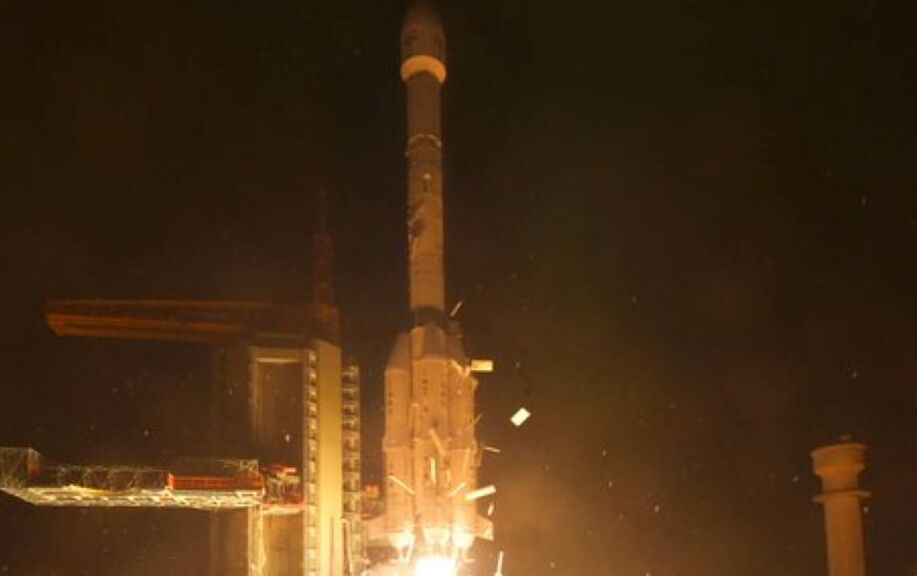
The Indian Space Research Organisation (ISRO) has achieved a major milestone in India’s space and defence capabilities with the successful launch of the advanced EOS-05 Earth observation satellite aboard the GSLV-F17 rocket. The mission lifted off from the Second Launch Pad at the Satish Dhawan Space Centre in Sriharikota at 2:55 am, marking ISRO’s first successful launch of the year.
The 51.7-metre-tall GSLV-F17 completed the mission as planned, with the approximately 2,367-kg EOS-05 satellite separating from the launch vehicle after around 19 minutes and being placed into its intended sub-geosynchronous transfer orbit. ISRO Chairman V. Narayanan described the achievement as a significant advancement, noting that the mission successfully delivered the heaviest Earth observation satellite launched by the GSLV to date.
EOS-05 is particularly significant because it is India’s first dedicated imaging satellite designed to operate from a geosynchronous orbit. Unlike conventional Earth observation satellites operating in low Earth orbit, the spacecraft is intended to operate at an altitude of roughly 36,000 km, allowing it to remain positioned over the same broad region of the Earth as it matches the planet’s rotation.
The satellite is expected to provide frequent and high-quality imagery that can support a wide range of applications, including agriculture, disaster management, environmental monitoring and other Earth observation requirements. Its ability to repeatedly observe the same region also gives the system important value for strategic monitoring and national security.
From a defence perspective, the mission represents an important expansion of India’s space-based surveillance architecture. Persistent observation from geosynchronous orbit can provide valuable data for monitoring sensitive areas, tracking changes on the ground and supporting situational awareness. The satellite has therefore been described as an “eye in the sky” because of its ability to maintain continuous observation of a designated region.
The EOS-05 mission also demonstrates the growing capabilities of India’s GSLV programme. GSLV-F17 was the 19th flight of the Geosynchronous Satellite Launch Vehicle, and its successful deployment of the 2,367-kg spacecraft represents an improvement in the launcher’s payload-delivery capability. The mission used an indigenous cryogenic upper stage as part of its three-stage configuration.
Following its successful injection into the transfer orbit, EOS-05 will undergo further orbital manoeuvres before reaching its operational geosynchronous position. Once operational, the spacecraft is expected to strengthen India’s ability to obtain timely Earth observation data from space.
The successful launch comes at an important time for India, as the country continues to expand the role of space-based assets in national security, disaster response, environmental monitoring and strategic decision-making. With EOS-05, ISRO has added another advanced capability to India’s growing Earth observation infrastructure, further strengthening the country’s position in space-based imaging and surveillance technology.