


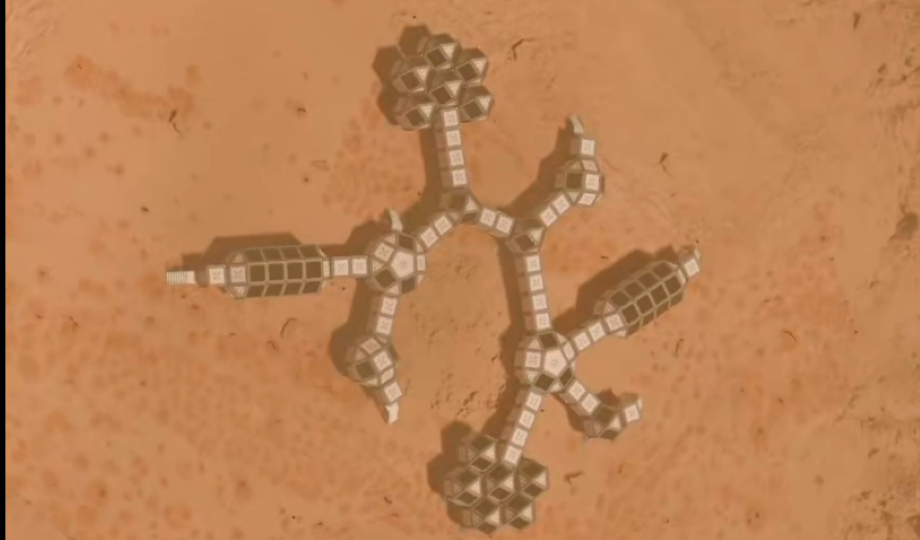
India is taking another step toward long-duration human space exploration with the development of BHEEM, a modular extraterrestrial habitat concept designed for future missions to the Moon and Mars. Developed by researchers at the Indian Institute of Science (IISc), Bengaluru, the concept explores how large, pressurised living spaces could be transported efficiently and assembled on another world.
BHEEM stands for Bhartiya Extraterrestrial Expandable Modular Habitat. The research was carried out by Mritunjay Baruah, Amogh Jadhav, Bimalendu Mahapatra, Group Captain Shubhanshu Shukla and Aloke Kumar at IISc. The project focuses on one of the major challenges facing future lunar and Martian settlements: how to transport and construct habitats capable of supporting astronauts while working within the payload limitations of launch vehicles.
Unlike conventional habitats that are transported as large, pre-built structures, BHEEM proposes a panel-based architecture. Individual panels can be stacked efficiently inside a launch vehicle and later assembled into pressurised modules after reaching the destination. This approach could make transportation, construction, maintenance and future expansion more practical for missions operating far from Earth.
The researchers studied human activities expected during lunar and Martian missions and used human-centred design principles to determine the space required for astronauts to live and work. Different geometric panel configurations, including triangular, square and pentagonal forms, were examined for volume efficiency and structural rigidity before suitable designs were selected.
A key feature of BHEEM is its modularity. The proposed architecture can be configured into different habitat layouts depending on mission requirements. Additional modules could also be incorporated as a settlement expands, potentially allowing the habitat to evolve from an initial base into a larger extraterrestrial living and working environment.
According to the research, a single Starship payload could potentially deploy a BHEEM configuration offering around twice the habitable volume of the International Space Station. The concept is specifically designed around the payload constraints of Starship, allowing its structural elements to be transported in a compact arrangement and assembled after landing.
Group Captain Shubhanshu Shukla has highlighted the importance of beginning research into extraterrestrial living environments well before humans establish permanent settlements beyond Earth. His involvement in the project connects India’s human-spaceflight programme with longer-term research into how astronauts could live and work after reaching destinations such as the Moon and Mars.
The BHEEM concept also reflects a broader shift in space exploration, where the focus is moving beyond simply reaching another celestial body toward developing the infrastructure required for sustained human presence. Future habitats will need to address challenges such as radiation exposure, extreme temperatures, life-support systems, structural safety and reliable maintenance.
For India, the project represents an important research direction as the country expands its human-spaceflight and deep-space ambitions. BHEEM remains a conceptual design and will require significant engineering development, testing and validation before any practical deployment can be considered. Nevertheless, its modular approach offers a potential pathway for building larger and more adaptable habitats on the Moon and, eventually, Mars.
The research demonstrates how India’s space ambitions are increasingly looking beyond launch vehicles and spacecraft toward the infrastructure that could support humans on other worlds. If concepts such as BHEEM progress from research into practical engineering solutions, they could contribute to the technologies needed for future permanent lunar and Martian settlements.