


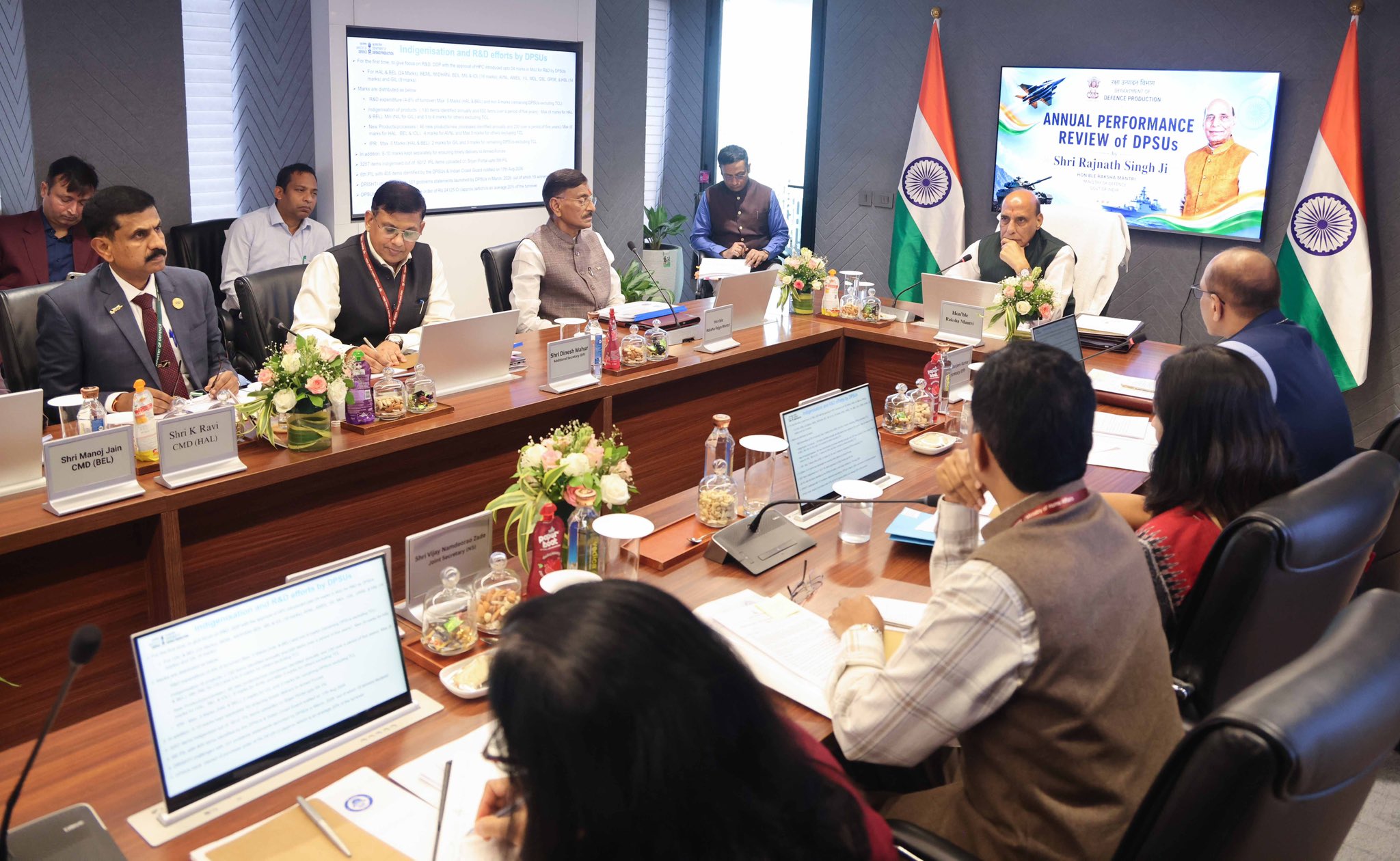
Defence Minister Rajnath Singh has called on India’s Defence Public Sector Undertakings (DPSUs) to accelerate indigenisation, reduce dependence on imported components, strengthen research and development and expand their presence in global defence markets. Singh issued the directions during a review meeting in New Delhi on September 1, where he assessed the annual performance of all 16 DPSUs and emphasised the need to build a more resilient and self-reliant defence industrial base.
The review comes as India’s defence manufacturing sector reaches a new milestone. According to the Defence Ministry, the country achieved its highest-ever annual defence production of approximately ₹1.8 lakh crore during 2025-26, with DPSUs contributing around ₹1.29 lakh crore. Singh described the achievement as an important reflection of India’s progress towards building an Aatmanirbhar defence manufacturing ecosystem.
During the meeting, Singh stressed that the performance of DPSUs is closely linked to national security. Recent global conflicts, he noted, have demonstrated the importance of assured supply chains, surge production capacity, availability of critical spares and rapid repair capabilities, particularly during prolonged conflicts. He urged DPSUs to improve delivery timelines and ensure that defence production can be sustained when operational requirements increase sharply.
A major focus of the review was reducing import dependence. Singh called on DPSUs to accelerate the indigenisation of products and processes while identifying areas where domestic industry can develop advanced technologies. He also stressed that greater spending on R&D should translate into tangible outcomes, including new technologies, intellectual property, prototypes and operational products rather than being measured only by expenditure.
The Defence Minister further encouraged DPSUs to identify niche technology areas in which India can move beyond self-reliance and emerge as a global leader. He also called for stronger collaboration with startups and micro, small and medium enterprises (MSMEs), along with greater capital expenditure to improve productivity and manufacturing capabilities.
Defence exports were another key priority highlighted by Singh. He urged DPSUs to raise the quality of their products to global standards and expand their international footprint under the “Make in India, Make for the World” approach. The objective is not only to meet the requirements of India’s armed forces but also to transform Indian defence manufacturers into globally competitive companies.
The annual review covered the major projects, manufacturing capabilities, technology development, exports and future expansion plans of the 16 DPSUs. During the meeting, seven DPSUs—Hindustan Aeronautics Limited (HAL), Mazagon Dock Shipbuilders Limited (MDL), Bharat Electronics Limited (BEL), Bharat Dynamics Limited (BDL), Garden Reach Shipbuilders & Engineers (GRSE), BEML and MIDHANI-also presented dividend cheques totalling ₹3,951 crore to the Defence Minister towards the government’s equity share for FY 2025-26.
Singh also released four publications focused on strengthening self-reliance and modernisation across the defence sector. These include a five-year roadmap for DPSU indigenisation, the DISHA initiative aimed at exposing students to defence technologies and modern manufacturing, and separate roadmaps for HAL’s modernisation and greater indigenous content in the aerospace and defence sectors.
The latest directives underline the government’s broader effort to move India’s defence industry from import dependence towards technology-driven self-reliance and export competitiveness. With defence production reaching a record level, the next challenge for DPSUs will be to convert this manufacturing growth into stronger indigenous technologies, faster deliveries and a larger share of the global defence market.