


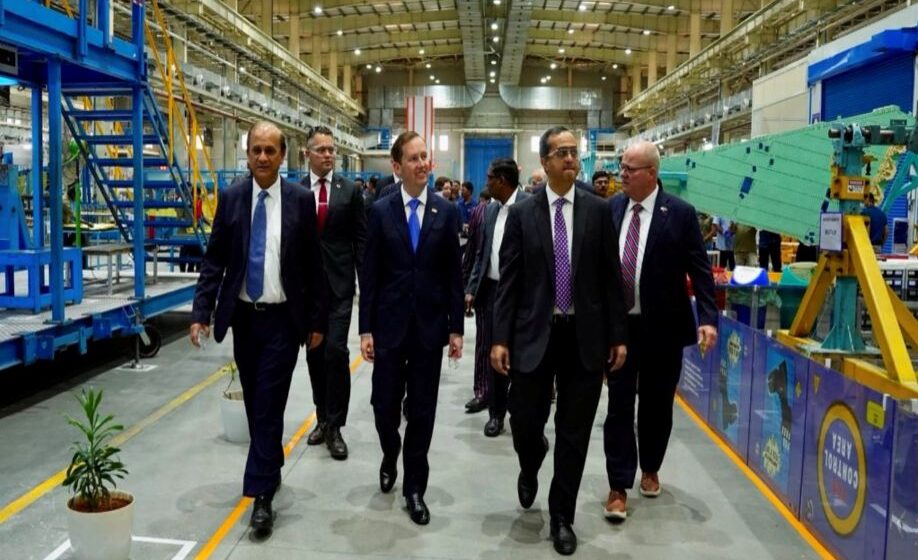
US Ambassador to India Sergio Gor has highlighted India’s increasingly important position in the global aerospace and defence manufacturing ecosystem during a visit to the Tata Lockheed Martin Aerostructures Limited (TLMAL) facility in Hyderabad.
During his visit, Gor observed advanced manufacturing activities linked to the C-130J Super Hercules, the tactical military transport aircraft operated by the Indian Air Force and several other countries. The visit highlighted how Indian private-sector manufacturing capabilities are becoming increasingly integrated into international defence supply chains.
TLMAL is a joint venture between Tata Advanced Systems Limited and Lockheed Martin Aeroframe Corporation. The Hyderabad facility has developed specialised capabilities for manufacturing major C-130J aerostructures and serves as a global supplier of empennages, or tail sections, for the C-130J and LM-100J aircraft. The plant also manufactures other significant aircraft structures, strengthening India’s role within the wider Super Hercules production network.
Gor described the partnership between Tata and Lockheed Martin as an important link in global C-130J production. He also pointed to its broader importance for strengthening defence supply chains and advancing the strategic relationship between India and the United States.
The collaboration is also moving beyond component production. Tata Advanced Systems and Lockheed Martin have been exploring additional opportunities related to the C-130J in India, including maintenance, repair and overhaul capabilities. A proposed MRO ecosystem could support India’s existing fleet of 12 C-130J aircraft while potentially serving other operators in the future.
Another significant opportunity is India’s Medium Transport Aircraft programme. The requirement is expected to involve around 60–80 aircraft to replace ageing transport fleets. The C-130J is among the aircraft being considered for the programme, alongside other international platforms. If selected, the Tata-Lockheed Martin partnership could potentially expand manufacturing and assembly activities in India, subject to the required approvals.
The development comes as India continues to push for greater domestic participation in defence manufacturing while simultaneously seeking deeper integration with global aerospace supply chains. Partnerships involving Indian companies and major international defence firms are helping expand local engineering, manufacturing and maintenance capabilities.
For the United States, India’s growing manufacturing contribution also offers an opportunity to create more resilient and diversified defence supply chains. For India, greater involvement in programmes such as the C-130J can strengthen its credentials as a global aerospace manufacturing hub rather than simply serving as an end-user of imported military equipment.
The Hyderabad facility therefore represents more than a production site. It reflects the broader evolution of India-US defence cooperation towards co-production, industrial partnerships and deeper supply-chain integration. With discussions around additional C-130J manufacturing and MRO capabilities continuing, India’s role in the global Super Hercules ecosystem could become even more significant in the coming years.