


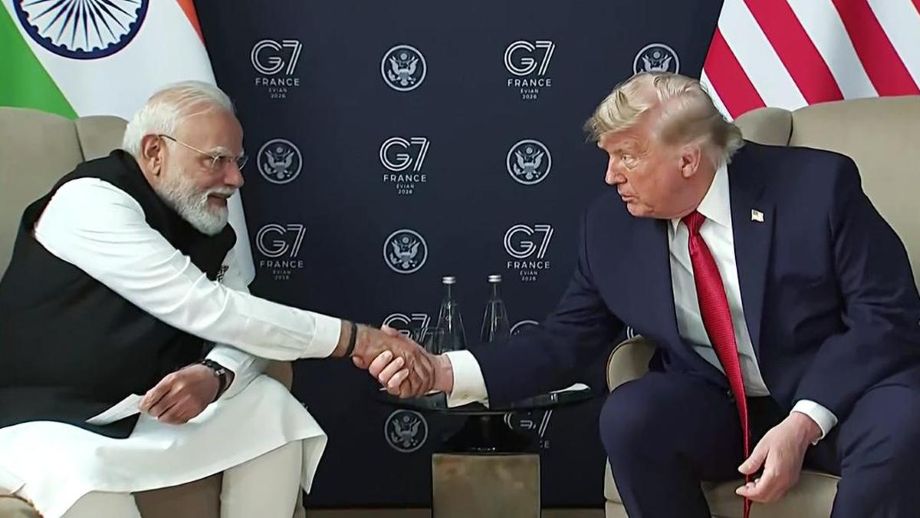
India’s efforts to maintain a controlled media format during Prime Minister Narendra Modi’s meeting with US President Donald Trump at the G7 Summit in France were reportedly overridden after Trump unexpectedly invited journalists to ask questions, according to remarks attributed to US Ambassador to India Sergio Gor.
The meeting between Modi and Trump took place on June 17, 2026, in Évian-les-Bains on the sidelines of the G7 Summit. According to the report, the Indian side had communicated through diplomatic channels that it preferred journalists to be present but that the meeting should not include questions. Such arrangements are described as part of standard protocol for high-level engagements and are intended to ensure that sensitive bilateral discussions remain focused.
Gor said the request was conveyed shortly before the meeting. He recalled that Trump initially accepted the arrangement after being briefed about the issues expected to be discussed. However, once the leaders were in front of the media, Trump reportedly turned to journalists and asked whether they had any questions.
The decision effectively transformed what was expected to be a controlled media appearance into an extended press interaction. The resulting session reportedly continued for around 45 minutes, with journalists directing a large number of questions toward the US president while Modi remained seated beside him.
The episode highlighted the diplomatic challenge of managing engagements with Trump, whose highly spontaneous public interactions have previously attracted international attention. For India, the preference for avoiding unscripted questions appears to have reflected a desire to prevent the meeting from being diverted by unexpected or politically sensitive exchanges.
The timing of the meeting was also significant. India was dealing with concerns surrounding the deaths of Indian sailors during a US military strike amid the wider conflict involving Iran and disruptions in the Strait of Hormuz. Maritime security and the protection of commercial shipping routes were therefore important issues in the broader diplomatic context.
Prime Minister Modi had raised concerns about the impact of instability in the region on civilian maritime traffic and international trade. Trump, however, reportedly took a different view of the risks faced by seafarers, describing the profession as inherently difficult.
Despite the unusual press interaction, the broader Modi-Trump meeting remained focused on the India-US relationship, including trade, defence cooperation and regional developments. Both countries have continued to attach strategic importance to their bilateral partnership amid rapidly changing geopolitical conditions.
Indian government sources, according to the report, maintained that the request for a no-question format was routine and consistent with arrangements followed during high-level visits. They indicated that the Indian side had not intended to impose an unusual restriction on the media but was seeking a predictable format for the leaders’ public appearance.
Gor’s account nevertheless provides an insight into the behind-the-scenes coordination that takes place before meetings involving senior leaders. It also illustrates how quickly such arrangements can change when leaders adopt an unscripted approach in front of the press.
The incident is therefore notable not only for the unexpected 45-minute media interaction but also for what it reveals about the differing diplomatic styles of New Delhi and Washington. While India sought a structured engagement, Trump’s spontaneous decision to take questions changed the character of the public portion of the meeting.
As India and the United States continue to deepen cooperation across defence, trade and strategic affairs, managing such high-level