


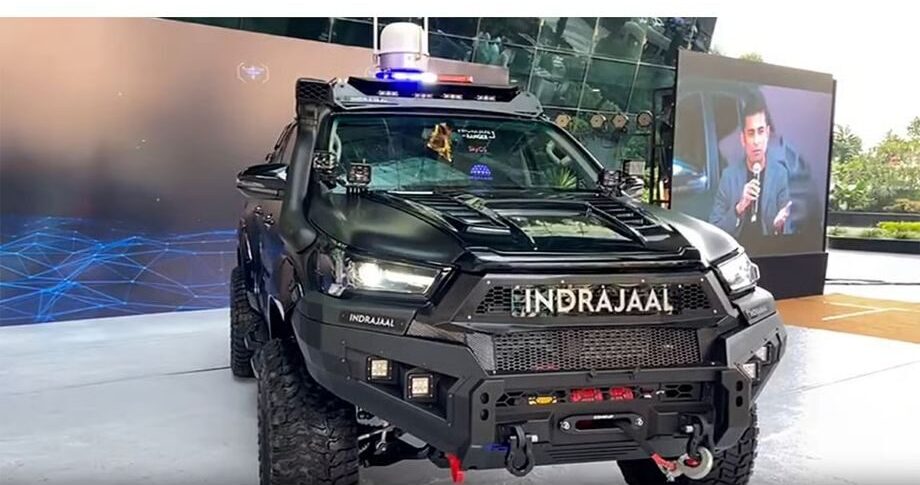
India is expanding its ability to counter the growing threat posed by unmanned aerial systems, with Hyderabad-based Indrajaal Autonomous Defense Systems and Sigma Advanced Systems securing orders worth approximately ₹155 crore for the Indrajaal Ranger anti-drone patrol vehicle.
The orders represent a significant push toward deploying mobile and autonomous counter-Unmanned Aircraft System (C-UAS) capabilities across both border-security and urban environments. Of the total amount, around ₹145 crore has been allocated for deployment in border-security operations, while a separate order valued at approximately ₹10 crore has been placed by urban police authorities for VVIP protection and security missions.
The Indrajaal Ranger is designed to address a key limitation of conventional counter-drone systems: their dependence on fixed locations. Mounted as a mobile anti-drone patrol vehicle, Ranger can transport its airspace-protection capability to locations where the threat emerges. This makes the system suitable for border areas as well as VVIP routes, major public gatherings and critical infrastructure.
At the centre of the platform is Indrajaal’s SkyOS, an AI-driven command-and-control architecture designed to combine sensor inputs, artificial intelligence, sensor fusion and countermeasures. The company’s platform integrates detection, tracking and response functions to provide continuous awareness of low-altitude airspace.
The Ranger employs multiple layers of counter-drone protection. Its Retractor capability is designed to take control of unauthorised drones and bring them down for controlled recovery and possible forensic examination. Another layer, known as Lakshman Rekha, establishes a virtual protective boundary around a designated area to restrict unauthorised drone activity. When electronic countermeasures are not sufficient, the Net Interceptor provides a physical means of capturing an intruding drone.
The mobile architecture is particularly relevant as drones are increasingly being used for surveillance, smuggling and other security threats. A system that can move with protected personnel or be rapidly positioned at sensitive locations can provide security agencies with greater flexibility than permanently installed counter-UAS infrastructure.
The partnership between Indrajaal and Sigma also reflects the growing role of India’s private defence industry in developing indigenous counter-drone technologies. Sigma has previously identified radar, sensing, jamming and spoofing technologies as part of its counter-UAS portfolio, while Indrajaal focuses on integrating such capabilities into autonomous anti-drone platforms.
The ₹155 crore orders therefore mark more than a commercial milestone for the two companies. They indicate a broader shift in India’s security architecture toward mobile, AI-enabled and layered counter-drone systems capable of operating across different environments.
As drone threats continue to evolve, the deployment of platforms such as the Indrajaal Ranger could give Indian security agencies a more flexible tool for protecting borders, high-value personnel and strategically important locations. The move also strengthens the position of indigenous defence technology developers in India’s rapidly expanding counter-UAS ecosystem.