


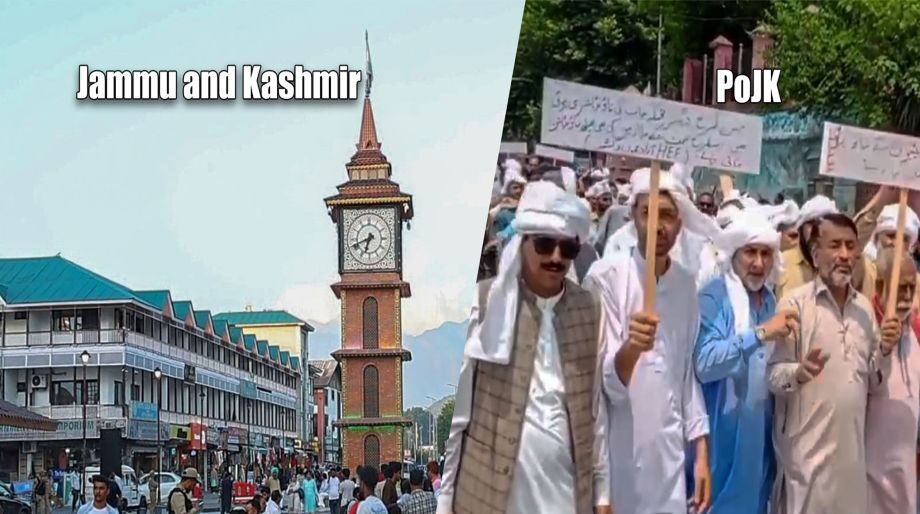
Five years after the revocation of Article 370, Jammu and Kashmir has witnessed significantly faster defence infrastructure development and military modernisation compared to Pakistan-occupied Kashmir, according to defence analysts tracking regional military buildups.
The anniversary of August 5, 2019, marks a watershed moment in India’s constitutional framework for the union territory. Beyond the political realignment, the operational landscape in J-K has undergone measurable transformation in terms of air defence systems, communication networks, and forward deployment postures across the Indian Air Force and Army.
The Indian Air Force has accelerated construction and upgrade projects at airfields across the valley, including enhanced hangars and dispersal facilities for fighter aircraft. These infrastructure gains support faster sortie generation and improved operational readiness in a theatre that remains strategically contested. The Air Force’s presence in Srinagar, Leh, and forward bases has become more robust, with improved all-weather capability and year-round operational tempo.
On the Pakistani side of the Line of Control, development has remained constrained. Pakistan-occupied Kashmir continues to lack comparable air defence modernisation, modern communications infrastructure, or equivalent civilian economic integration. The region’s isolation from Pakistan’s broader development narrative remains pronounced, with limited private investment and infrastructure spending compared to Indian-administered J-K’s post-2019 trajectory.
India’s focus since 2019 has extended beyond military posturing to civilian governance, with central government funding for schools, hospitals, and road networks accelerating across the valley. This dual approach has created a visible development gap that extends into defence-related industries and skill development. The establishment of defence manufacturing clusters and increased employment in aerospace and defence sectors across J-K has added an economic dimension to India’s strategic presence.
The Indian Army has simultaneously strengthened its forward positions and logistical networks, with improved road connectivity to high-altitude posts enhancing rapid deployment capability. Border management has become more technology-enabled, with surveillance and counter-infiltration operations supported by upgraded communication systems and unmanned platforms.
For Pakistan, the asymmetry presents a long-term challenge. Economic constraints on defence spending, combined with security challenges in Balochistan and Sindh, have left Pakistan-occupied Kashmir as a lower-priority zone in terms of military modernisation. The region remains militarily administered with minimal civil development, a stark contrast to the trajectory of Indian J-K’s integration with national defence and economic frameworks.
The five-year period has demonstrated that constitutional and administrative changes, when paired with military modernisation and economic investment, can decisively reshape a disputed territory’s strategic character. India’s approach has blended hard military capability with soft governance, creating a model of territorial consolidation that extends beyond the LoC into the broader subcontinent’s geopolitical narrative.