


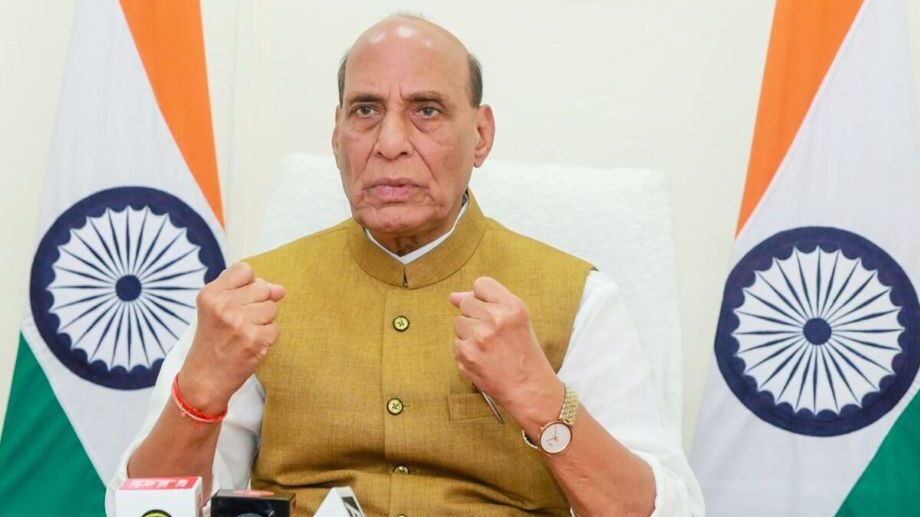
Defence Minister Rajnath Singh has called for greater structural integration between the military and civilian wings of the Ministry of Defence to strengthen India’s defence capability against evolving security and technological threats.
Addressing the 85th Armed Forces Headquarters Civilian Services Day celebrations in New Delhi on August 3, 2026, Singh emphasised that effective civil-military synergy requires both uniformed and administrative cadres to operate within a unified framework rather than along separate institutional paths.
The Defence Minister underscored that the shared commitment to ‘Nation First’ becomes national strength when institutional objectives align. He stressed that as joint and integrated command structures develop across the ministry, continuity of expertise in policy formulation, human resource management, and defence administration must be preserved and enhanced across transitions.
Singh highlighted the Armed Forces Headquarters (AFHQ) cadre as the institutional memory of the Ministry of Defence. The AFHQ provides continuity, domain expertise, and policy stability that no single temporary appointee or posting cycle can replicate. This permanent institutional infrastructure acts as a critical bridge for civil-military cohesion.
The Defence Minister urged expanded cross-exposure between civilian and military officers through structured joint training programmes and developmental assignments. This exchange of experience is vital for building mutual understanding of operational constraints, policy realities, and administrative requirements on both sides.
Singh called on AFHQ cadre to extend their contribution beyond routine mandate compliance into defence technology research, geo-strategic analysis, and innovation initiatives that strengthen India’s broader defence ecosystem. This expansion reflects a shift toward leveraging permanent institutional expertise as a strategic asset rather than treating civil service roles as purely administrative.
The emphasis on civil-military integration reflects India’s approach to modernizing defence administration. The permanent bureaucratic structure of defence ministries worldwide provides institutional continuity that political leadership and temporary military postings cannot sustain. India’s defence challenges, from border security to space defence capabilities and industrial self-reliance, require seamless knowledge transfer and policy consistency across leadership changes.
The AFHQ civilian cadre, established under the reorganized defence ministry structure, handles critical functions spanning defence policy coordination, budget management, acquisitions oversight, and inter-service coordination. Their institutional memory directly influences how quickly new defence initiatives gain traction and how effectively military capability requirements translate into procurement decisions and industrial partnerships.