


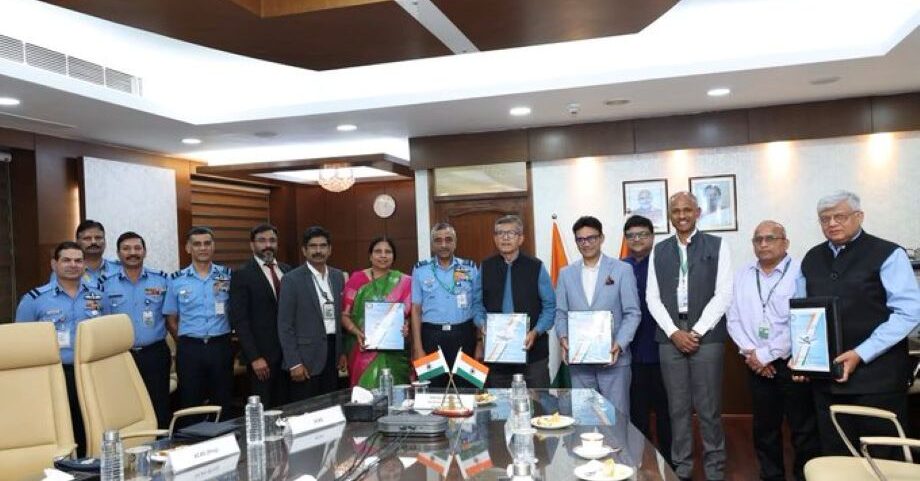
India has taken another major step toward strengthening its airborne surveillance and command capabilities after the Defence Research and Development Organisation (DRDO) signed two crucial industry contracts for the Airborne Early Warning & Control (AEW&C) Mk-II programme. The agreements pave the way for the conversion of six Airbus A321 passenger aircraft into advanced Netra Mk-II airborne warning and control platforms for the Indian Air Force (IAF).
The contracts were signed by DRDO’s Centre for Air Borne Systems (CABS), the nodal laboratory responsible for developing India’s indigenous AEW&C systems. Under the first agreement, AI Engineering Services Limited (AIESL) will convert six Airbus A321 aircraft from commercial airliners into “green” military-ready platforms capable of hosting sophisticated surveillance equipment.
The second contract has been awarded to Adani Defence Systems and Technologies Limited (ADSTL), which has been selected as the Development-cum-Production Partner for the mission systems that will be integrated into the aircraft. These mission systems will form the technological backbone of the Netra Mk-II platform, enabling advanced airborne surveillance, secure communications, battle management, and command-and-control operations.
The Netra Mk-II programme represents one of India’s most ambitious indigenous airborne surveillance initiatives. Compared with the existing Netra aircraft operating on smaller Embraer platforms, the Airbus A321-based system will offer significantly greater endurance, higher payload capacity, improved radar performance, and enhanced operational flexibility. The larger aircraft will also accommodate more powerful sensors and mission equipment, allowing the Indian Air Force to monitor larger areas of airspace during extended missions.
According to DRDO, the new AEW&C Mk-II system is expected to provide advanced airborne surveillance, improved situational awareness, secure communication links, and enhanced command-and-control capabilities. These improvements will strengthen India’s ability to detect, track, and coordinate responses against aerial threats over extended distances, significantly boosting national air defence preparedness.
The programme is also a major milestone for the Government’s Aatmanirbhar Bharat initiative, highlighting increasing participation from Indian industry in complex aerospace and defence projects. By combining DRDO’s indigenous technologies with domestic industrial partners for aircraft conversion and mission system development, India aims to reduce dependence on foreign suppliers while building a stronger defence manufacturing ecosystem.
Once the aircraft conversion is completed, CABS will integrate the indigenous mission systems before the aircraft undergo an extensive flight testing and certification process in collaboration with the Indian Air Force. Upon successful trials, the six Netra Mk-II aircraft are expected to become a critical force multiplier for the IAF, enhancing India’s surveillance, early warning, and battlefield management capabilities in an increasingly complex regional security environment.