


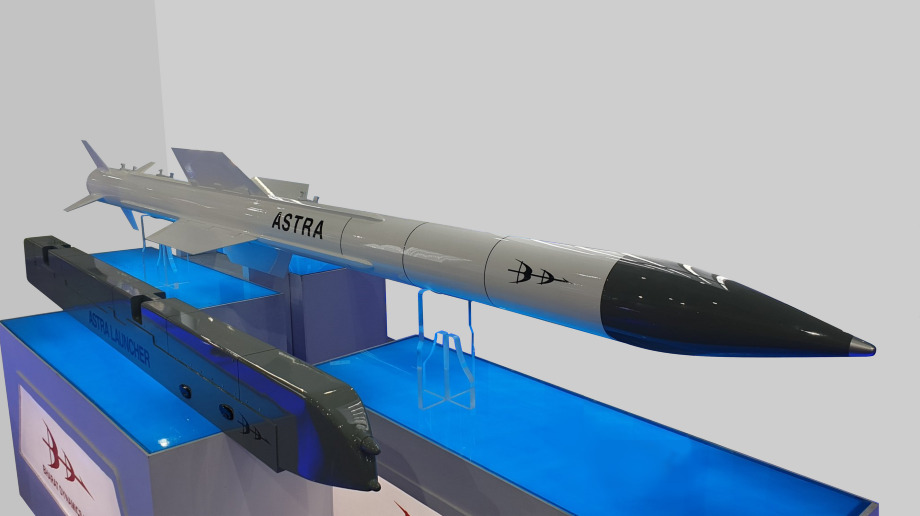
Six nations, including Armenia and Saudi Arabia, have expressed interest in acquiring India’s ASTRA Beyond Visual Range air-to-air missile, signalling growing international confidence in the indigenously developed weapon system.
The ASTRA is a medium-range air-to-air missile designed and developed by the Defence Research and Development Organisation (DRDO) at Hyderabad. It was operationally inducted into the Indian Air Force in 2020 after a development cycle spanning over two decades, making it one of India’s most significant achievements in guided weapon systems.
The missile carries a 15 kg warhead and operates on an all-aspect engagement profile with a range exceeding 80 km in its current variants. It is equipped with an active radar seeker and inertial navigation system, enabling it to engage aerial targets beyond the visual range of the launching fighter aircraft. The ASTRA can be integrated across the IAF’s fighter fleet, including Tejas, Gripen, Rafale, and MiG-29 platforms.
DRDO has progressively enhanced the ASTRA’s capabilities since its induction. The missile’s integration with the Tejas Light Combat Aircraft was a landmark achievement, validating India’s ability to develop a complete air-to-air combat ecosystem indigenously. Export interest from multiple nations reflects both the system’s technical maturity and India’s growing credibility as a defence technology exporter.
The interest from Armenia is particularly significant given regional security dynamics in the Caucasus, while Saudi Arabia’s approach aligns with the Kingdom’s broader defence modernisation programme and deepening defence partnership with India. Both nations operate fighter aircraft compatible with or capable of being modified to accommodate the ASTRA system.
India’s Defence Ministry has progressively opened the door to selective defence exports under the Make in India initiative, with the ASTRA emerging as a marquee candidate for international sales. The missile’s export potential also strengthens the Indian defence industrial ecosystem, particularly DRDO’s Hyderabad-based Advanced Systems Laboratory, the primary developmental agency.
The ASTRA represents a critical capability gap that India addressed through indigenous development. Prior to induction, the IAF relied on imported air-to-air missiles such as the Hispano-built Mica and Russian R-77 systems. The ASTRA’s development vindicated India’s long-term investment in guided weapon research and demonstrated DRDO’s capacity to deliver systems competitive with global benchmarks in range, seeker technology, and integration complexity.
International interest in the ASTRA also underscores India’s emerging role as a reliable defence technology partner for nations seeking alternatives to traditional Western or Russian suppliers. Formal export frameworks and government-to-government negotiations are likely underway to facilitate potential sales to interested nations.