

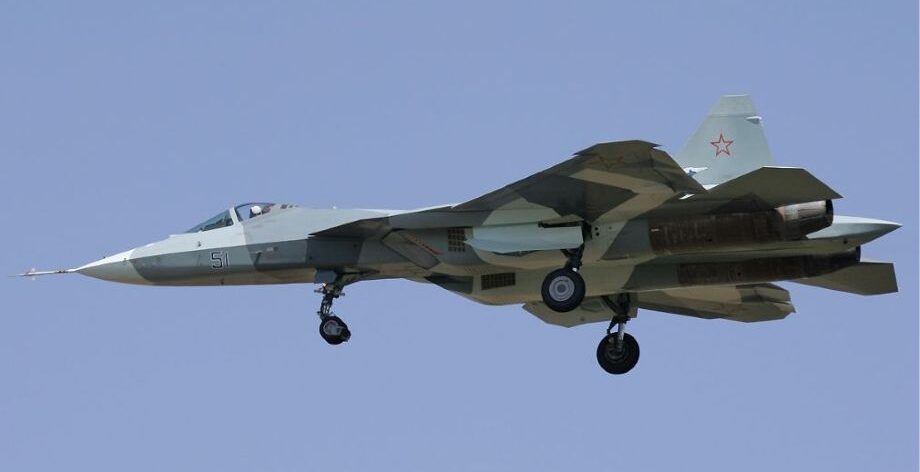
Russia has renewed its push to sell the Su-57 fifth-generation stealth fighter to India, reportedly offering a broader package that goes beyond the supply of aircraft. The proposal is said to include advanced air-launched weapons, technology transfer, domestic production opportunities and possible technical cooperation linked to India’s indigenous Advanced Medium Combat Aircraft (AMCA) programme.
The renewed Russian proposal comes as India evaluates options for strengthening its future fighter fleet while continuing work on the AMCA. India currently does not operate a fifth-generation fighter, making the development of a credible stealth combat capability an important long-term requirement for the Indian Air Force.
Russia has been attempting to make the Su-57 more attractive to New Delhi by offering deeper industrial cooperation. Instead of limiting the proposal to an aircraft sale, Moscow has reportedly indicated its willingness to support local manufacturing and provide greater access to technologies associated with the fighter.
The package could involve an initial procurement of around 36 to 40 Su-57 aircraft, followed by expanded production in India. Hindustan Aeronautics Limited’s Nashik facility has been discussed in connection with potential domestic manufacturing. Such an arrangement could allow India to gain experience in producing and maintaining a fifth-generation fighter while increasing the involvement of its domestic aerospace industry.
Weapons integration is another major component of the Russian proposal. The Su-57 can carry a range of modern air-to-air and air-to-ground weapons, and Russia has reportedly highlighted systems such as the Kh-69 stealth cruise missile and R-37M long-range air-to-air missile. The Kh-69 would provide a long-range stand-off strike capability, while the R-37M is designed to engage high-value airborne targets at extended ranges.
Russia has also reportedly linked the proposal to advanced and hypersonic weapon capabilities. However, specific details about the weapons that could ultimately be supplied to India, as well as their integration and operational configuration, have not been officially confirmed.
Technology transfer could be one of the most important aspects of Moscow’s renewed offer. Russia has previously indicated its willingness to provide extensive technical cooperation, including access to aircraft technologies and greater freedom for India to integrate indigenous systems. Such cooperation could potentially allow Indian-made avionics, sensors and weapons to be incorporated into the aircraft.
For India, this aspect is significant because New Delhi has increasingly focused on domestic defence manufacturing and technology development. A Su-57 arrangement involving substantial technology transfer and local production could therefore provide benefits beyond the immediate acquisition of a new fighter aircraft.
Moscow is also reportedly offering technical assistance for India’s AMCA programme. The proposal could allow Russia to position the Su-57 as a near- to medium-term solution while India continues developing its own fifth-generation fighter. However, such cooperation would need to be carefully evaluated against India’s objective of building an independent domestic combat-aircraft capability.
India has previously been involved with Russia in the earlier Fifth Generation Fighter Aircraft programme, but the partnership did not progress into a production aircraft. Concerns over cost, technology access, design requirements and capability were among the issues associated with the earlier programme.
The current Russian proposal therefore comes at a different stage in India’s aerospace development. New Delhi has gained greater experience in indigenous fighter production through programmes such as the Tejas and is now pursuing the more ambitious AMCA project.
For the Indian Air Force, the decision will ultimately depend on several factors, including the Su-57’s operational capabilities, technology transfer, production arrangements, lifecycle costs, weapons integration and compatibility with India’s future combat-aircraft strategy.
There is currently no confirmed Indian decision to procure the Su-57. Russia’s latest offer nevertheless demonstrates Moscow’s determination to remain a major defence and aerospace partner for India. By combining the fighter with advanced weapons, industrial cooperation and possible AMCA-related assistance, Russia is seeking to present the Su-57 as a broader strategic package rather than simply another foreign fighter acquisition.