


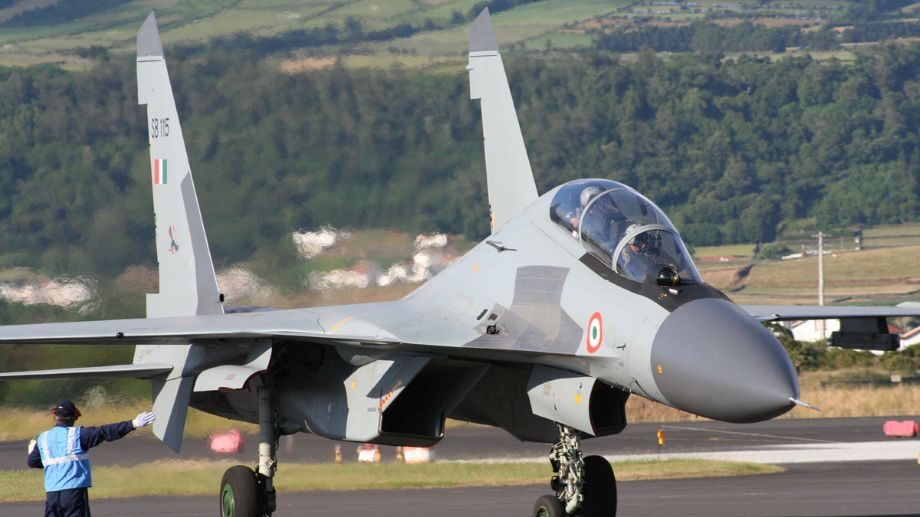
The Su-30MKI air superiority fighter will be equipped with India’s largest Active Electronically Scanned Array (AESA) radar as part of a major avionics upgrade, according to sources tracking the programme. The new radar will be paired with a redesigned radome to optimise aerodynamic performance and sensor integration.
The Su-30MKI is the Indian Air Force’s primary long-range air-to-air combat platform and forms the backbone of the force’s air superiority capability. Since the 1990s, the aircraft has undergone continuous upgrades to enhance situational awareness, weapon integration, and sensor fusion across its fleet of over 270 aircraft.
An AESA radar offers superior target detection and tracking across longer ranges compared to the mechanically scanned array systems it would replace. The technology enables the aircraft to detect and engage multiple targets simultaneously while maintaining a low probability of intercept. For the Su-30MKI, an AESA upgrade represents a critical step toward matching the sensor performance of fourth-generation plus fighters entering service globally.
The radome redesign is significant because the radar antenna’s protective housing directly affects both electromagnetic performance and aerodynamic drag. A purpose-built radome allows the AESA to operate at optimal efficiency without the losses that occur when retrofitting new sensors into legacy airframes. The structural changes also support the integration of India’s indigenous avionics ecosystem, aligning with the Make in India agenda.
DRDO’s Defence Electronics Research Laboratory (DERL) has been developing AESA radar technology for Indian combat platforms for over a decade. The institute has delivered radar systems for the Tejas light combat aircraft and continues work on airborne, naval, and ground-based variants. An AESA system tailored for the Su-30MKI would represent one of the most powerful radar installations on any Indian military aircraft to date.
The Su-30MKI upgrade fits within the broader Su-30 Series Modernisation programme, which also includes integration of standoff air-to-ground missiles, enhanced electronic warfare suites, and improved cockpit avionics. These incremental enhancements extend the operational life of the aircraft and maintain Indian Air Force superiority through the 2030s, while indigenous manufacturing of upgrades reduces dependence on foreign contractors for critical systems.
Integration of an indigenous AESA radar represents a significant technological milestone for India’s defence aerospace sector and demonstrates deepening capability in active phased-array systems. The upgrade will enhance the Su-30MKI’s interoperability with other IAF platforms and improve its role in integrated air defence operations across the subcontinent.