

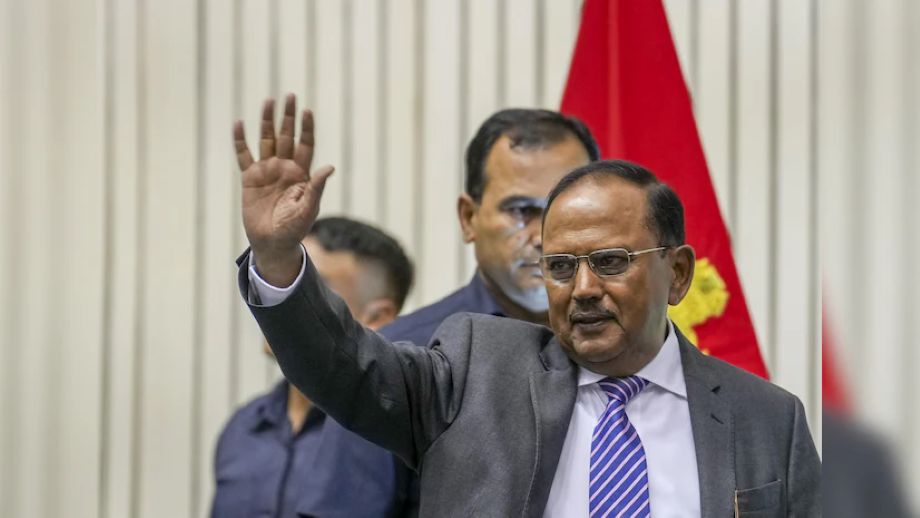
India’s response to the Pahalgam terror attack was driven by a clear political directive to identify those responsible and pursue them wherever they were, National Security Advisor Ajit Doval has said. His remarks provide fresh insight into the decision-making process that preceded Operation Sindoor and the military actions that followed.
Speaking in the documentary series Declassified: Operation Sindoor, Doval recalled the immediate discussions with Prime Minister Narendra Modi after the April 22, 2025 attack in Pahalgam, Jammu and Kashmir. The attack, which killed 26 people, triggered a major national security response and intensified scrutiny of the networks responsible for cross-border terrorism.
According to Doval, the Prime Minister sought immediate clarity about the perpetrators and those behind the attack. The focus was on establishing responsibility through intelligence and ensuring that the individuals and organisations involved could be pursued irrespective of their location.
Doval’s account highlights the importance of intelligence agencies in establishing the identities and networks connected to the attack. The information gathered subsequently helped provide the foundation for India’s response, which culminated in Operation Sindoor on May 7, 2025.
Under Operation Sindoor, Indian forces conducted strikes against terrorist infrastructure in Pakistan and Pakistan-occupied Jammu and Kashmir. The operation represented a significant escalation in India’s counter-terrorism approach, with the stated objective of targeting infrastructure associated with attacks against India rather than treating terrorism solely as a diplomatic issue.
The confrontation subsequently widened as Pakistan launched military actions, prompting further Indian counter-strikes. The military exchange continued for several days before India and Pakistan reached an understanding on May 10, 2025.
Doval has also emphasised that India’s response was not confined to kinetic military operations. The broader strategy involved diplomatic engagement, economic measures, intelligence coordination and information efforts designed to increase pressure on terrorism and its supporting networks.
The documentary also features senior Indian military leaders who provide accounts of the planning and execution of Operation Sindoor. Their assessments underline the coordinated role of the Indian Army, Navy and Air Force in responding to the evolving security situation.
The subsequent elimination of the terrorists identified as directly involved in the Pahalgam attack further reinforced India’s stated objective of bringing those responsible to justice. Operation Mahadev later targeted the individuals allegedly linked to the attack, involving the Army, CRPF and Jammu and Kashmir Police.
Doval’s latest account offers a broader perspective on the thinking behind India’s response. Rather than viewing the Pahalgam attack as an isolated incident, the government treated it as a major national-security challenge requiring intelligence-driven action and the willingness to employ military power when necessary.
The episode also demonstrated how India’s counter-terrorism strategy has increasingly combined intelligence, precision military capabilities and wider national-power instruments. For India’s defence establishment, Operation Sindoor therefore represents not only a military operation but also an example of how political direction, intelligence assessment and the armed forces can be integrated during a major security crisis.