


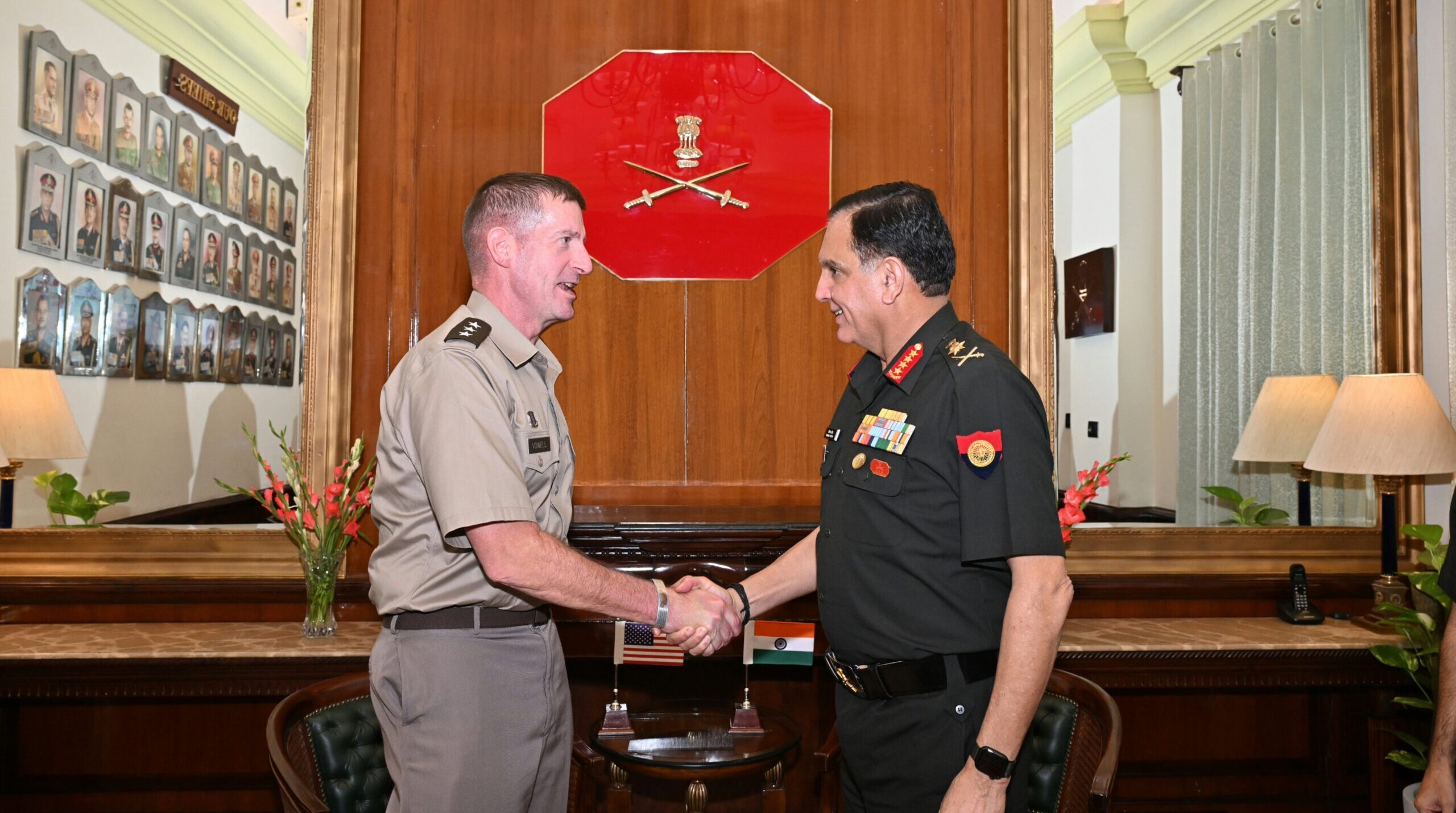
India and the United States have reviewed the evolving security situation in the Indo-Pacific and discussed opportunities to further strengthen bilateral defence cooperation, as military engagement between the two countries continues to expand.
The discussions took place in New Delhi on September 28 between Indian Army Chief General Dhiraj Seth and Lieutenant General Joel B Vowell, Deputy Commanding General of the United States Army Pacific (USARPAC). The meeting focused on the changing security landscape in the Indo-Pacific and measures to advance defence engagement between the two countries across multiple areas.
According to the Indian Army, the two military leaders also discussed ways to enhance interoperability through joint training and military exercises. The focus reflects the growing importance of operational coordination between Indian and US forces as both countries expand their military-to-military engagement.
The latest discussions followed the successful conclusion of Exercise Yudh Abhyas 2026, one of the major recurring exercises between the Indian and US armies. The 22nd edition of the bilateral exercise was conducted at Auli in Uttarakhand and the Mahajan Field Firing Range in Rajasthan.
Yudh Abhyas 2026 brought together around 600 personnel from each country and involved training across a range of operational situations. The exercise included high-altitude warfare, long-range precision fires, counter-drone operations and integrated command-and-control activities.
The exercise provided Indian and US troops with opportunities to train together and improve their understanding of each other’s operational procedures, tactics and techniques. The United States Army said the 2026 exercise was focused on readiness, interoperability and cooperation between the two forces.
The Indian Army has increasingly expanded its engagement with the US military through exercises and professional exchanges, with interoperability becoming an important component of the broader defence relationship. The latest meeting between General Seth and Lieutenant General Vowell further highlighted this focus amid changing security dynamics across the Indo-Pacific.
The discussions also come as India and the United States continue to strengthen their wider defence partnership in areas beyond military exercises. On September 28, Defence Secretary Rajesh Kumar Singh separately met a visiting bipartisan US Congressional delegation led by Representative Brian Mast, Chairman of the House Foreign Affairs Committee.
The meeting examined ways to strengthen the India-US Comprehensive Global Strategic Partnership, with particular attention to defence industrial and technological cooperation. Discussions included opportunities for greater collaboration in defence technology, production and industrial capabilities.
The combination of military exercises, senior-level military dialogue and defence industrial cooperation reflects the expanding scope of India-US defence relations. Operational cooperation is increasingly being supported by discussions on technology, defence production and industrial partnerships.
The Indo-Pacific remains an important area of strategic engagement for both countries. India has continued to strengthen military relationships with the United States and other regional partners while developing its capabilities across the Indian Ocean and wider Indo-Pacific region.
The latest India-US discussions therefore underline the continuing emphasis on military readiness, interoperability and defence cooperation. With joint exercises such as Yudh Abhyas providing practical training opportunities and high-level engagements addressing broader strategic and industrial cooperation, the two countries are continuing to develop multiple dimensions of their defence partnership.
The September 28 meeting between General Dhiraj Seth and Lieutenant General Joel B Vowell represents another step in this ongoing military engagement, particularly as India and the United States continue to examine ways to improve coordination and cooperation in response to the evolving Indo-Pacific security environment.