

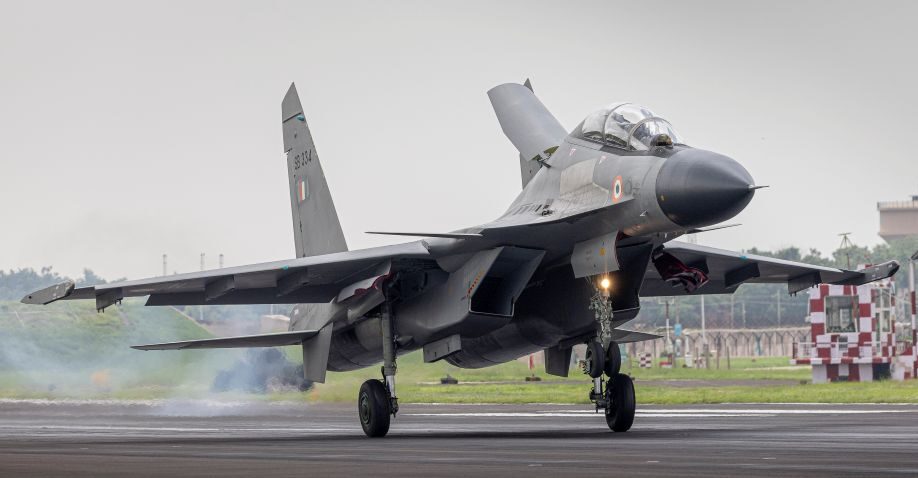
India is not expected to place fresh orders for the Sukhoi Su-30MKI, marking a significant shift in the Indian Air Force’s long-term combat aviation strategy. Instead of expanding its fleet of the twin-engine multirole fighter, the government is prioritising the modernisation of existing aircraft while evaluating future fifth-generation capabilities and accelerating indigenous fighter programmes.
The Su-30MKI has served as the backbone of the Indian Air Force for over two decades, with more than 270 aircraft inducted into service. While the platform continues to play a central role in India’s air combat capability, defence planners now appear to favour upgrading the existing fleet rather than investing in additional airframes.
This approach aligns with the ongoing “Super Sukhoi” modernisation programme, which is expected to significantly enhance the operational capabilities of the aircraft. The upgrade package is likely to include advanced active electronically scanned array (AESA) radar, indigenous mission computers, modern electronic warfare systems, improved cockpit displays and the integration of next-generation Indian weapons. The programme also aims to increase indigenous content, reducing long-term dependence on imported components.
The development comes as Russia continues to promote the export version of its Su-57 fifth-generation stealth fighter to India. Moscow has proposed local manufacturing, technology transfer and the use of existing Su-30MKI production infrastructure at HAL’s Nashik facility should New Delhi decide to proceed with the aircraft. However, Indian authorities have not announced any decision regarding the acquisition of the Su-57, and discussions remain at an exploratory stage.
At the same time, India’s indigenous Advanced Medium Combat Aircraft (AMCA) programme remains the country’s primary long-term solution for acquiring a fifth-generation stealth fighter. The AMCA is expected to form the backbone of the Indian Air Force’s future combat fleet, complementing the Tejas Mk-2 and upgraded Su-30MKI aircraft in the coming decades.
Military analysts believe the decision to avoid fresh Su-30MKI procurement reflects a broader transition in India’s air power strategy. Rather than increasing the number of fourth-generation fighters, the emphasis is shifting towards enhancing existing capabilities while preparing for the induction of next-generation platforms capable of operating in increasingly contested airspace.
With regional air forces rapidly inducting advanced combat aircraft, the Indian Air Force is seeking to balance immediate operational requirements with long-term technological advancement. Upgrading the existing Su-30MKI fleet offers a cost-effective means of maintaining combat readiness while the country pursues indigenous fifth-generation capabilities and evaluates future procurement options.