

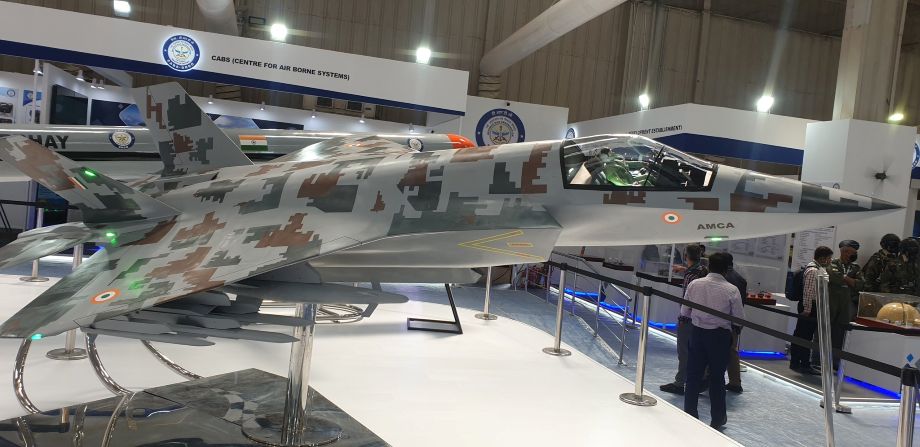
India is expected to select a private-sector development partner for its Advanced Medium Combat Aircraft (AMCA) programme within the next month, marking an important milestone in the country’s indigenous fifth-generation fighter project. Defence Secretary Rajesh Kumar Singh confirmed on November 16 that proposals from all three shortlisted bidders had been received and were under government evaluation.
The three contenders are Tata Advanced Systems Limited (TASL), an L&T-led consortium involving Bharat Electronics Limited (BEL) and Dynamatic Technologies, and a Bharat Forge-led consortium comprising BEML Limited and Data Patterns. All three submitted their bids on October 30 after the government extended the original deadline.
The selected company will work alongside the Aeronautical Development Agency (ADA), under the Defence Research and Development Organisation (DRDO), to manufacture five flying prototypes and one structural test specimen. ADA will retain design authority and oversee the aircraft’s technical development, while the selected industry partner will lead prototype manufacturing.
The AMCA development programme is estimated to cost approximately ₹15,000 crore. The aircraft is being designed as a twin-engine, single-seat fifth-generation stealth fighter in the 25-tonne class. Its planned capabilities include low-observable stealth technology, internal weapons bays, advanced radar, artificial intelligence-assisted avionics, sensor fusion and supercruise capability.
The five flying prototypes are expected to undergo an extensive testing programme involving approximately 1,800 sorties over seven years. These trials will evaluate flight performance, radar systems, stealth characteristics, weapons integration and other critical technologies.
The initial prototypes are expected to be powered by GE Aerospace F414 engines. For future versions, India is exploring the development of a more powerful indigenous engine through cooperation involving DRDO’s Gas Turbine Research Establishment (GTRE) and French aerospace company Safran. A separate proposal involving Reliance Industries and Rolls-Royce has also been considered.
The AMCA programme is strategically important as China has already introduced fifth-generation fighters, including the J-20 and J-35. India aims to strengthen the Indian Air Force’s future combat capabilities while reducing dependence on foreign fighter aircraft.
The selection of the development partner will also create new opportunities for India’s private defence industry. With the government expected to announce its decision within a month, the programme is approaching a crucial transition from development planning towards prototype manufacturing and flight testing.