


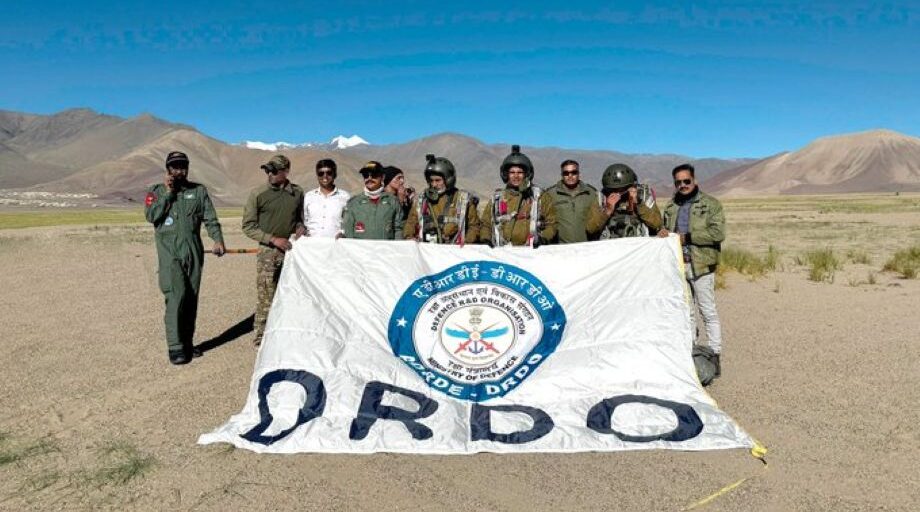
The Defence Research and Development Organisation (DRDO) has successfully tested India’s indigenously developed Military Combat Parachute System (MCPS) at an altitude of 22,000 feet in Ladakh, demonstrating its capability to support airborne military operations in extreme high-altitude conditions.
The trial was conducted at the Nyoma-Mudh drop zone, one of the world’s highest-altitude drop zones, where temperatures fell to around -15°C. The successful test marks another step in India’s efforts to strengthen indigenous capabilities for specialised military operations.
The MCPS has been designed and developed by DRDO’s Aerial Delivery Research and Development Establishment (ADRDE) in Agra, along with support from the Defence Bioengineering and Electromedical Laboratory (DEBEL) in Bengaluru.
During the trial, ADRDE test jumpers Wing Commander Rahul Jha, Master Warrant Officer R J Singh and Master Warrant Officer Vivek Tiwari carried out the jump from 22,000 feet above mean sea level. The parachute was deployed at approximately 20,000 feet, while the jumpers landed safely at an altitude of around 13,700 feet.
The test team also used indigenous supporting equipment, including a para computer, oxygen system and specialised jumpsuits, alongside the MCPS. These systems are intended to support personnel operating in the demanding environmental conditions associated with high-altitude parachute operations.
According to DRDO, the successful trial demonstrated the efficacy, reliability and tactical employability of the Military Combat Parachute System under extreme high-altitude conditions. The achievement highlights the growing role of indigenous defence technologies in supporting the operational requirements of the Indian Armed Forces.
The MCPS has previously demonstrated its capability in high-altitude combat freefall operations. DRDO has stated that the system incorporates enhanced tactical features, including a lower rate of descent and improved steering capability, allowing paratroopers to deploy at predetermined altitudes, navigate towards designated areas and achieve controlled landings.
The latest Ladakh trial is particularly significant because parachute operations at very high altitudes involve challenging environmental factors such as low temperatures, reduced atmospheric density and demanding oxygen requirements. Successful testing under these conditions provides valuable validation of the system for specialised airborne missions.
The development and testing of the MCPS also supports India’s broader objective of achieving greater self-reliance in critical defence technologies. Indigenous systems such as the MCPS can reduce dependence on foreign equipment while strengthening the country’s ability to develop and maintain specialised military capabilities domestically.
With the successful high-altitude trial in Ladakh, DRDO has further demonstrated the progress being made in India’s indigenous aerial delivery and airborne warfare technologies.