

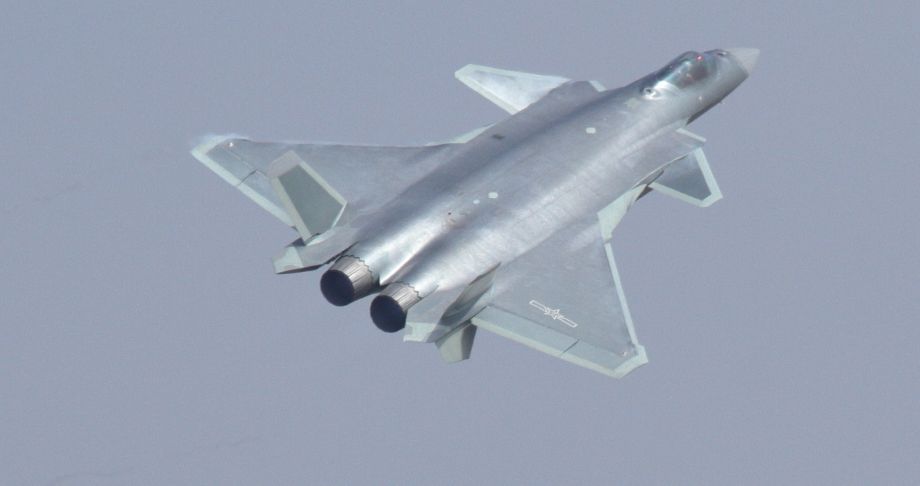
China has significantly expanded the deployment of its Chengdu J-20 stealth fighter fleet at strategic airbases facing India, signalling another step in Beijing’s effort to strengthen its military posture opposite India. Fresh commercial satellite imagery has revealed an increased presence of the People’s Liberation Army Air Force’s (PLAAF) most advanced combat aircraft at strategically located bases in western China and Tibet.
According to the latest satellite assessment, at least 11 J-20 stealth fighters have been identified at Hotan Air Base in Xinjiang and Damxung Air Base in Tibet. These locations provide China with the ability to rapidly project air power across the Himalayan frontier while supporting high-altitude military operations.
The Chengdu J-20, often referred to as the “Mighty Dragon,” is China’s premier fifth-generation stealth fighter. Designed for air superiority missions, the aircraft combines low-observable characteristics with advanced sensors, long-range air-to-air missiles and modern avionics, allowing it to engage enemy aircraft before being detected. Over the past several years, the PLAAF has steadily expanded J-20 production and frontline deployment as part of its broader military modernisation programme.
The latest deployment reflects a noticeable shift from occasional rotational deployments to a more sustained presence of advanced combat aircraft near India’s northern frontier. Defence analysts believe such positioning improves the PLAAF’s readiness for rapid response missions while strengthening China’s air dominance capabilities in the region.
For India, the development underscores the widening gap in fifth-generation fighter capability. While the Indian Air Force continues to operate a modern fleet of Rafale, Su-30MKI, Mirage 2000 and indigenous Tejas fighters, the country’s indigenous Advanced Medium Combat Aircraft (AMCA) programme is still under development and has yet to enter operational service.
Military experts note that India’s integrated air defence network, long-range surveillance systems and planned force modernisation will remain critical in maintaining deterrence along the India-China border. Simultaneously, New Delhi continues to pursue indigenous aerospace development while enhancing the capabilities of existing fighter fleets through advanced sensors, weapons and network-centric warfare systems.
China’s continued expansion of its J-20 fleet, combined with regular infrastructure upgrades across the Tibetan Plateau and the Western Theatre Command, indicates that airpower will remain a central element of the military balance along the India-China border in the coming years. The latest satellite imagery reinforces concerns that both sides will continue investing heavily in advanced aerospace capabilities as strategic competition in the region intensifies.