

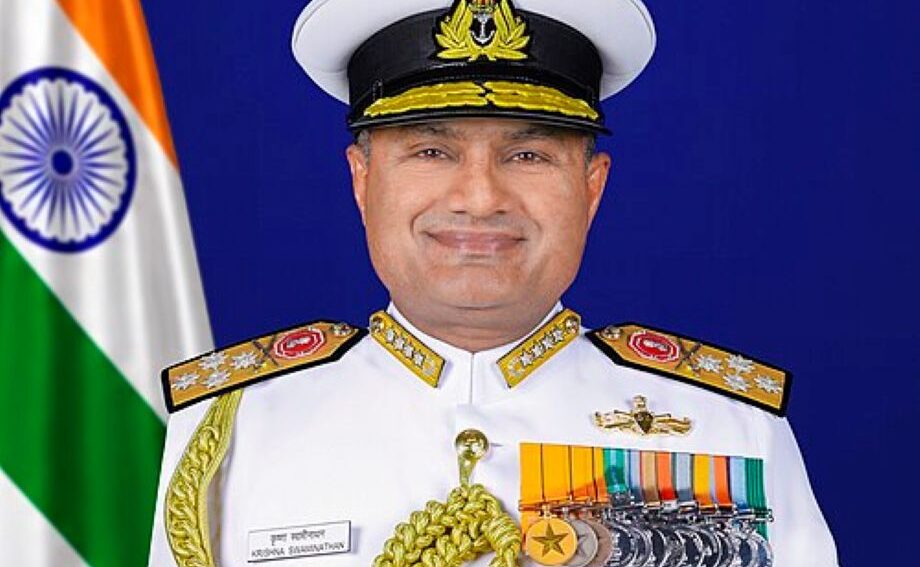
More than 85 per cent of Pakistan’s military equipment is of Chinese origin, highlighting Beijing’s dominant role in supplying weapons and military technology to Islamabad. Chief of the Naval Staff Admiral Krishna Swaminathan made the observation while discussing regional security challenges and Pakistan’s evolving military capabilities at the ANI National Security Summit 3.0 in New Delhi.
According to Admiral Swaminathan, Pakistan also operates some military equipment sourced from Turkey, although Chinese-origin platforms account for the overwhelming majority of its military inventory. He said India remains fully aware of the capabilities available to Pakistan’s armed forces and continuously monitors developments that could affect the country’s security interests.
The Navy Chief also addressed concerns surrounding the growing defence relationship between China and Pakistan, particularly its potential implications for maritime security. He clarified that the Indian Navy does not approach regional security exclusively through the conventional framework of a one-front or two-front conflict. Instead, its focus remains on maintaining operational preparedness against different types of threats across the maritime domain.
A major area of concern highlighted during the discussion was Pakistan’s planned acquisition of eight Hangor-class submarines, developed from China’s Type 039B Yuan-class submarine design. The induction of these vessels is expected to significantly strengthen the Pakistan Navy’s underwater warfare capabilities, introducing operational advantages that its existing submarine fleet has not possessed at the same level.
Admiral Swaminathan acknowledged that the eight submarines would represent a formidable addition to Pakistan’s naval strength. Their introduction could have implications for the maritime balance in the Indian Ocean Region, where underwater surveillance, anti-submarine warfare and control of critical sea routes remain important elements of naval strategy.
However, the Navy Chief expressed confidence in India’s ability to address potential underwater threats. He said the Indian Navy has established plans and capabilities to deal with adversary submarines and understands the operational challenges associated with their deployment. He also highlighted India’s continuing efforts to expand its own submarine fleet and strengthen its overall maritime combat capabilities.
India’s approach to maintaining its maritime advantage involves the coordinated use of submarines, surface combatants and naval aviation assets. According to Swaminathan, the country’s understanding of regional maritime geography, operational experience and surveillance capabilities provide an important foundation for responding to emerging challenges.
The Admiral also pointed out that China’s naval presence in the Indian Ocean is not a new development. Chinese naval deployments have maintained an almost continuous presence in the region since September or October 2008. Consequently, the Indian Navy has been monitoring China’s maritime activities and incorporating its evolving operational patterns into India’s broader maritime security planning.
On the wider strategic relationship between Beijing and Islamabad, Swaminathan explained that the Indian military follows the national policy framework established by the government and does not independently treat China and Pakistan as a single security entity. India maintains separate relationships with both countries while remaining attentive to their respective military developments.
He also reiterated India’s position on freedom of navigation, describing international waters as a global common space where countries should be able to operate for legitimate purposes in accordance with international norms.
The Navy Chief’s remarks underline the growing importance of submarine warfare and maritime preparedness as China’s defence partnership with Pakistan continues to influence regional security calculations. With Pakistan preparing to strengthen its underwater fleet through Chinese-origin submarines, India is expected to maintain its focus on surveillance, fleet modernisation and operational readiness to safeguard its interests across the Indian Ocean Region.