


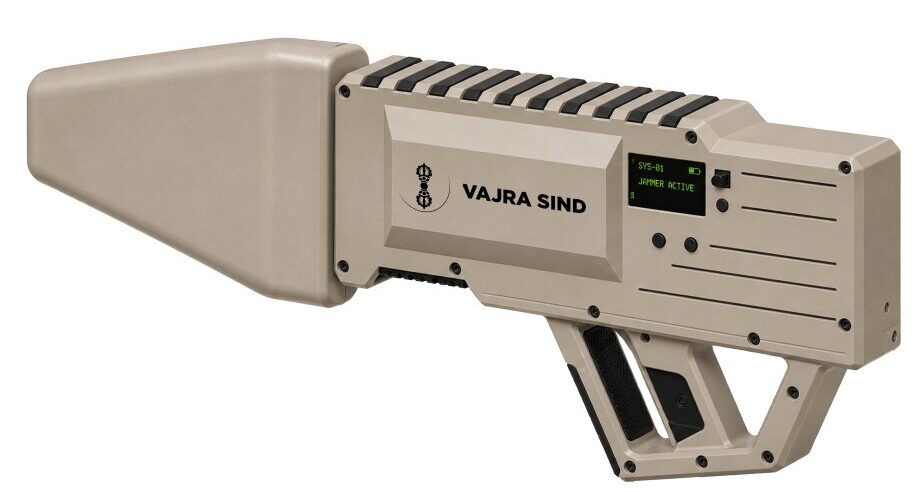
India’s indigenous defence technology sector has taken another step towards strengthening battlefield protection against unmanned aerial threats, with Chennai-based Big Bang Boom Solutions (BBBS) introducing its Vajra Sind handheld radio-frequency (RF) jammer. Unveiled on November 17, 2026, the system has been designed to give frontline military personnel a portable electronic countermeasure against hostile drones operating across multiple communication frequency bands.
The introduction of Vajra Sind comes amid the increasing use of small unmanned aerial vehicles for surveillance, reconnaissance and attack missions. Their relatively low cost, ease of deployment and ability to operate close to military positions have made them a growing concern for armed forces. Against this backdrop, portable electronic warfare equipment capable of disrupting drone communications is becoming an important component of modern battlefield defence.
Vajra Sind is designed to address this challenge through a wideband RF jamming architecture covering frequencies from 400 MHz to 6 GHz. According to BBBS, its frequency coverage enables the system to counter drones operating across a broader spectrum than conventional solutions restricted to selected communication bands. The system also features configurable frequency bands, allowing its jamming configuration to be adapted to different operational requirements.
One of the key features of the newly introduced platform is its compact, soldier-portable design. Weighing less than five kilograms, Vajra Sind is intended for rapid deployment by personnel operating in the field. Its one-button activation mechanism is designed to simplify operation, while an integrated self-check status display provides information about the system’s operational condition.
BBBS has also indicated that the platform can be integrated with a handheld drone detection device. Such an arrangement could provide personnel with a more comprehensive portable counter-drone capability by combining threat detection with electronic countermeasures. However, the company has not announced a specific induction or procurement contract for Vajra Sind.
The system’s development reflects lessons drawn from the changing character of drone warfare, including operational experience associated with Operation Sindoor. BBBS highlighted the need to move beyond countermeasures focused primarily on commonly used ISM frequency bands, pointing to the importance of wider frequency coverage when dealing with diverse unmanned aerial threats.
The unveiling took place during a visit by Major General Roopesh Mehta, PVSM, SM, VSM, to the company’s Chennai headquarters. Serving as Additional Director, Capability Development (B), he has been involved in the Indian Army’s capability development and procurement-related activities. During the event, he acknowledged the importance of developing indigenous technologies to address the changing requirements of modern military operations.
Dr. Shivaraman Ramaswamy, Founder and Chief Technology Officer of BBBS, highlighted the company’s efforts to translate operational requirements into practical defence technologies. The development of Vajra Sind, according to the company, reflects its focus on indigenous research, engineering and intellectual property in the electronic warfare and counter-drone domain.
The new jammer also expands the company’s Vajra family of counter-unmanned aircraft systems, which includes solutions designed for different detection and engagement ranges. BBBS has previously developed the Vajra Sentinel counter-drone platform, which the company says has been supplied to India’s Army, Air Force and Navy, as well as exported to friendly foreign countries. The earlier programme also received support through the Ministry of Defence’s Innovations for Defence Excellence (iDEX) initiative.
Established in 2018, Big Bang Boom Solutions has been developing technologies across defence electronics, artificial intelligence, autonomous systems, robotics and electronic warfare. Its latest unveiling highlights the expanding role of India’s private defence manufacturers in addressing specialised military requirements through domestic innovation.
As drone threats continue to evolve, the ability to detect, disrupt and neutralise hostile unmanned aircraft is becoming increasingly important for military forces. With its wide frequency coverage and lightweight configuration, Vajra Sind is intended to offer frontline personnel another option in India’s developing counter-drone technology ecosystem.