


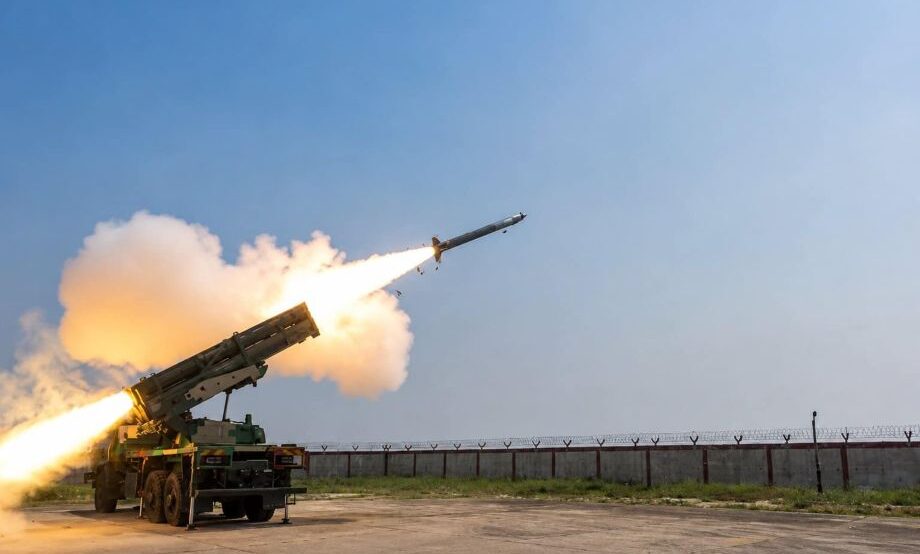
India’s efforts to strengthen its long-range precision strike capabilities have received a boost after NIBE Limited successfully completed fresh firing trials of the Suryastra Universal Rocket Launcher System at the Integrated Test Range (ITR) in Chandipur, Odisha. The latest trials were conducted on November 11, 2026, and demonstrated the system’s ability to fire rockets across four different ranges of 30 km, 50 km, 150 km and 300 km.
The latest demonstration represents another important step in the development of Suryastra, a multi-calibre rocket artillery system designed to provide the Indian Army with flexible and long-range precision strike capabilities. The successful firing trials highlight the platform’s ability to support different operational requirements through a common launcher architecture, allowing the armed forces to select ammunition according to the required engagement distance and mission profile.
Suryastra is being manufactured in India by NIBE Limited through a technology collaboration with Israeli defence company Elbit Systems. The partnership, established in July 2025, combines Elbit’s experience in developing advanced multiple rocket launcher technology with NIBE’s domestic manufacturing capabilities. The system is based on the concept of a universal rocket launcher, which can accommodate different types of rockets rather than relying on separate launch platforms for individual ammunition categories.
The four ranges demonstrated during the November trials expand the operational flexibility associated with the system. The 30 km and 50 km firing capabilities can support shorter-range battlefield engagements, while the 150 km and 300 km variants provide the Indian Army with options for deeper precision strikes. This range flexibility could help commanders respond to different battlefield situations using a common weapons platform.
The latest development follows earlier successful demonstrations conducted by NIBE Limited at Chandipur in May 2026. During those trials, the company tested the 150 km and 300 km rocket variants on May 18 and 19. The rockets reportedly achieved Circular Error Probable (CEP) values of approximately 1.5 metres and 2 metres, respectively. CEP is a standard military measurement used to assess the accuracy of a weapon system by indicating the radius within which 50 per cent of projectiles are expected to land around the intended target.
The Indian Army had placed an order with NIBE Limited in January 2026 under its emergency procurement programme for the supply of Suryastra launchers, associated ground equipment and rockets. The initial contract was valued at approximately ₹292.69 crore and covered ammunition with strike ranges of 150 km and 300 km. The procurement reflects the Army’s interest in strengthening its long-range rocket artillery capabilities while increasing the participation of domestic defence manufacturers.
One of the important operational features associated with Suryastra is its multi-calibre design and shoot-and-scoot capability. The system is intended to operate from a mobile launcher platform, allowing it to fire its ammunition and relocate quickly after completing an engagement. Such mobility is particularly valuable in modern battlefield environments, where rocket artillery units must reduce their exposure to enemy surveillance and counter-battery fire.
The development also highlights the growing role of India’s private defence industry in the production of advanced military equipment. NIBE Limited’s involvement in the programme reflects the increasing participation of domestic companies in manufacturing complex weapon systems through international technology partnerships and local production capabilities.
For the Indian Army, a launcher capable of operating across multiple engagement ranges could offer greater flexibility in planning artillery operations and responding to changing battlefield requirements. However, the November firing trials should be viewed as a development milestone rather than confirmation of full-scale operational deployment. Further production, deliveries and military evaluation will determine the system’s future role within the Army’s rocket artillery structure.
With the latest successful demonstration at Chandipur, Suryastra continues to advance as an important part of India’s efforts to strengthen its long-range precision strike capabilities. The programme also supports the broader Aatmanirbhar Bharat initiative by encouraging domestic manufacturing, technology absorption and greater private-sector participation in India’s defence industrial ecosystem.