


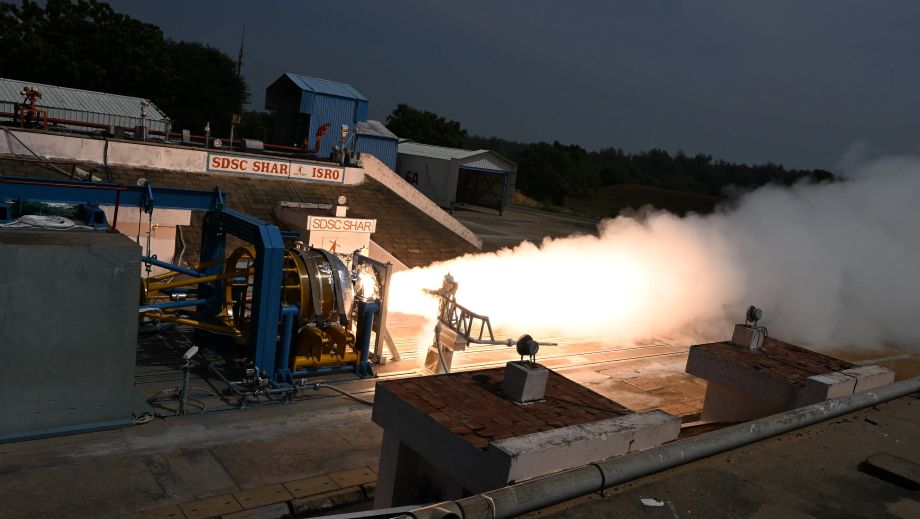
The Indian Space Research Organisation (ISRO) has successfully completed a ground static test of the upgraded third stage of its Polar Satellite Launch Vehicle (PSLV), marking a significant development in efforts to strengthen the reliability of India’s workhorse launch vehicle. The test was conducted on November 12, 2026, at the Static Test Facility of the Satish Dhawan Space Centre (SDSC-SHAR) in Sriharikota, Andhra Pradesh.
The successful test comes after technical anomalies were observed in the third stage, known as PS3, during the PSLV-C61/EOS-09 and PSLV-C62/EOS-N1 missions. Following these incidents, ISRO initiated a comprehensive review of the stage’s configuration, focusing on its design margins, raw material acceptance standards, assembly procedures and existing quality-control measures.
As part of the corrective measures, the space agency introduced several improvements to the PS3 solid motor stage to enhance its structural integrity and operational reliability. Particular attention was given to the nozzle configuration, which underwent modifications to improve design margins. The nozzle plays an important role in directing exhaust gases generated by the solid motor and producing the thrust required for rocket propulsion.
ISRO also strengthened the mechanical interfaces of the third stage and introduced additional redundancy in its sealing systems. These changes are intended to improve the robustness of critical connections and reduce the possibility of failures associated with sealing arrangements. The adequacy of the revised design margins was also verified during the modification process.
Alongside the structural improvements, ISRO revised its procedures for accepting raw materials and assembling the solid motor stage. Additional quality checks were incorporated to strengthen oversight throughout the manufacturing and integration process. The agency also implemented updated Non-Destructive Testing (NDT) procedures during different phases of integration and transportation. These inspection methods allow engineers to examine the condition and integrity of components without causing damage to them.
Following the implementation of these modifications, ISRO developed a revised version of the PS3 solid motor stage and subjected it to a ground static test. The successful completion of this test demonstrates that the modified stage has cleared an important ground-testing milestone. However, the results do not yet represent a return to operational flight status, as additional technical assessments and testing remain necessary.
ISRO has stated that the data collected during the static test will undergo detailed analysis and review. Further tests will be planned based on the findings from this evaluation. The agency has not announced a specific timeline for the completion of the remaining tests or the next PSLV mission.
The latest development is particularly important for the PSLV programme, which has played a central role in India’s satellite launch capabilities for decades. The four-stage launch vehicle has supported numerous national and international satellite missions and remains an important part of India’s space infrastructure. Its capabilities are essential for launching Earth-observation, scientific and other satellites into designated orbits.
The successful testing of the upgraded PS3 stage represents progress in ISRO’s efforts to address the technical concerns identified during previous missions. By strengthening the nozzle configuration, mechanical interfaces, sealing arrangements and manufacturing quality-control procedures, the space agency is working to improve the consistency and reliability of the launch vehicle.
While the successful ground test is an encouraging development, the detailed evaluation of test data and completion of further validation activities will determine the next steps for the PSLV programme. The outcome will be important for restoring confidence in the launch vehicle and ensuring the reliability of its future missions.