

India’s human spaceflight ambitions are moving closer to a major milestone as the Indian Space Research Organisation (ISRO) prepares for the first uncrewed test flight of its Gaganyaan programme in December 2026. Designated Gaganyaan-G1, the mission will mark the first orbital test of the spacecraft developed to carry Indian astronauts into space.
ISRO Chairman V. Narayanan has confirmed the December launch target, indicating that preparations for the mission are progressing. The flight will take place from the Satish Dhawan Space Centre in Sriharikota, Andhra Pradesh, using the Human Rated Launch Vehicle Mark-3 (HLVM3), an upgraded version of India’s LVM3 rocket specifically configured for human spaceflight operations.
The Gaganyaan-G1 mission will carry Vyommitra, ISRO’s specially developed half-humanoid robot, instead of human astronauts. The robotic passenger will help engineers assess the spacecraft’s internal environment and evaluate systems designed to support astronauts during future missions. Its flight will provide important information about cabin conditions, life-support operations and the performance of onboard systems under actual spaceflight conditions.
According to the latest programme update, approximately 7,700 of the planned 10,000 tests have been completed, representing around 77 per cent of the overall testing programme. The remaining qualification activities are expected to continue through March 2027 as ISRO works towards validating the technologies and equipment required for human spaceflight. These tests cover different components of the launch vehicle, spacecraft, safety arrangements and mission operations.
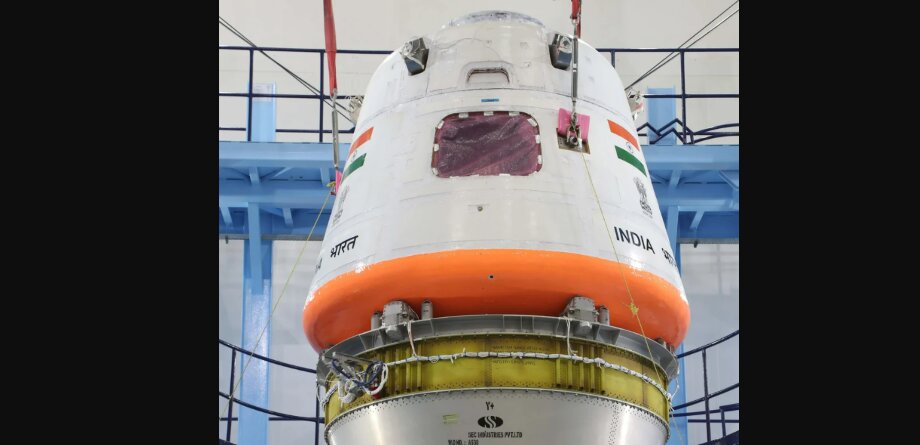
During Gaganyaan-G1, ISRO will evaluate the performance of the Crew Module and Service Module in low-Earth orbit. The mission will also demonstrate critical capabilities associated with spacecraft re-entry, parachute deployment and recovery following splashdown. These operations are essential to ensuring that a crewed spacecraft can withstand the demanding conditions of returning through Earth’s atmosphere and safely reach the designated recovery area.
The Crew Module is the pressurised spacecraft section designed to accommodate astronauts, while the Service Module provides essential support during the orbital phase. Together, these systems form the core of the Gaganyaan spacecraft. Their performance during the uncrewed mission will help ISRO assess whether the integrated spacecraft configuration is ready for subsequent stages of the programme.
ISRO has already carried out several important tests to reduce technical risks before the first orbital flight. These include demonstrations of the Crew Escape System, parachute qualification activities, integrated air-drop trials and tests involving the separation of the Crew Module and Service Module. The successful completion of these activities has contributed to the development and validation of systems required to protect astronauts throughout the mission.
The HLVM3 rocket will play a central role in India’s human spaceflight programme. Since carrying astronauts requires considerably higher safety standards than conventional satellite launches, the vehicle has undergone modifications to improve reliability and incorporate additional safety provisions. Its human-rated configuration is designed to transport the Gaganyaan spacecraft into the required low-Earth orbit while meeting the demanding requirements of crewed operations.
Gaganyaan-G1 is part of a phased testing strategy through which ISRO intends to demonstrate the reliability of its spacecraft and associated technologies before sending astronauts into orbit. The first uncrewed flight will be followed by additional uncrewed missions to further validate the integrated systems and operational procedures ahead of the first human spaceflight.
India’s first crewed Gaganyaan mission is targeted for 2027. The programme aims to demonstrate the country’s ability to independently launch Indian astronauts into low-Earth orbit, maintain human operations in space for several days and bring the crew safely back to Earth.
With the first uncrewed flight targeted for December 2026, Gaganyaan is entering an important phase of its development. The outcome of the G1 mission will provide a crucial assessment of India’s human-rated launch vehicle, spacecraft technologies and recovery capabilities, bringing the country closer to achieving its first indigenous human spaceflight.