

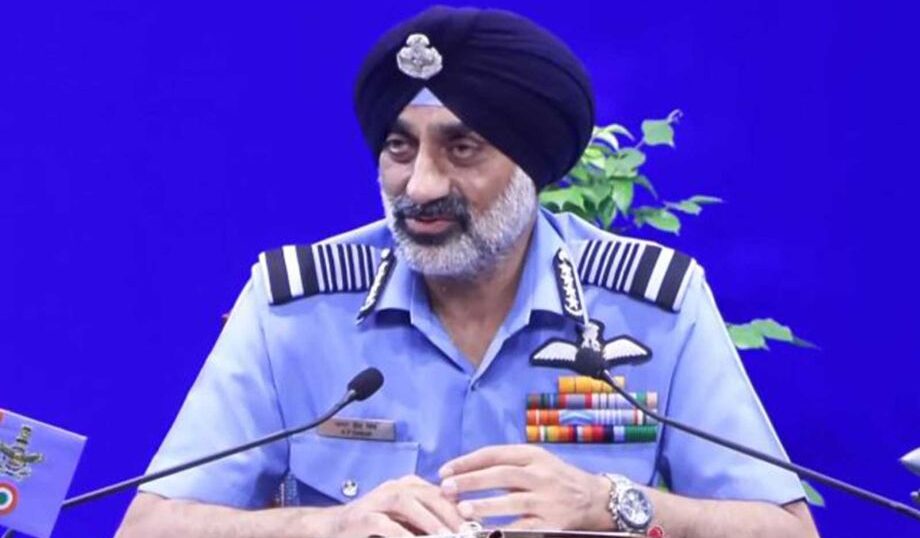
India remains capable of dealing with the emerging challenge posed by fifth-generation fighter aircraft being developed by China, Air Chief Marshal A.P. Singh said while acknowledging concerns over the possibility of Pakistan acquiring advanced Chinese stealth fighters.
Speaking at the Indian Air Force’s annual press conference in New Delhi ahead of Air Force Day, Air Chief Marshal Singh said reports of Pakistan potentially acquiring Chinese fifth-generation fighter aircraft were a matter of concern, but did not mean that India would be unable to respond effectively.
According to the Air Chief, the effectiveness of a modern fighter aircraft depends not only on the capabilities of the platform itself but also on how well it is integrated with a wider military system. Sensors, command-and-control networks, airborne surveillance assets, electronic warfare systems, data links, air defence networks and other supporting capabilities can play a decisive role in determining combat effectiveness.
Singh’s remarks came amid reports that Pakistan could acquire Chinese fifth-generation fighter aircraft and that Pakistani pilots may already be receiving training in China to operate such platforms. While acknowledging the potential development, he maintained that the acquisition of an advanced aircraft alone would not automatically provide an adversary with air superiority.
The Air Chief also referred to the experience of Operation Sindoor, pointing out that the possession of advanced military platforms does not by itself guarantee operational success. The ability to integrate different systems and employ them effectively as part of a broader combat network is increasingly important in modern air warfare.
At the same time, Singh stressed that India cannot afford to become complacent. He called for the early induction of aircraft belonging to the same technological generation and highlighted the importance of accelerating India’s indigenous Advanced Medium Combat Aircraft (AMCA) programme.
The AMCA is being developed as India’s future fifth-generation stealth fighter and is expected to provide the Indian Air Force with a domestically developed platform featuring advanced avionics, sensors, stealth characteristics and network-centric combat capabilities. The programme is considered a major component of India’s long-term effort to strengthen indigenous fighter aircraft development and reduce dependence on foreign platforms.
Singh indicated that delays in the AMCA programme could force India to consider alternative options to ensure that the IAF does not fall behind in next-generation combat aviation. His comments underline the growing urgency surrounding India’s fighter modernisation requirements as China continues to expand its advanced combat aircraft capabilities and Pakistan explores closer cooperation with Beijing.
The IAF is also dealing with a shortage of fighter squadrons. Air Chief Marshal Singh has said the force currently has 29 fighter squadrons against an authorised strength of 42 and needs to induct around 36 to 40 fighter aircraft annually for the next few years to address the shortfall.
Alongside the development of the AMCA, India is pursuing several programmes aimed at strengthening its combat fleet, including the induction of Tejas Mk-1A aircraft and efforts to advance the Multi-Role Fighter Aircraft programme. The IAF has also been focusing on improving beyond-visual-range combat capabilities and integrating increasingly sophisticated sensors, weapons and networked systems.
The Air Chief’s latest comments therefore highlight a two-track requirement for the Indian Air Force: maintaining the ability to counter immediate regional threats with existing and incoming capabilities while rapidly developing and inducting next-generation fighter technology.
For India, the AMCA programme is particularly significant because it is intended to provide a long-term indigenous solution for fifth-generation air combat. Faster progress on the programme, combined with timely induction of other fighter aircraft, will be critical to maintaining the IAF’s operational readiness as the air-power balance in the region continues to evolve.
Air Chief Marshal Singh’s assessment makes clear that India’s response to the fifth-generation fighter challenge will not depend on a single aircraft. Instead, the effectiveness of the IAF will increasingly depend on the integration of fighters, missiles, sensors, electronic warfare, air defence and command networks into a unified combat ecosystem.