


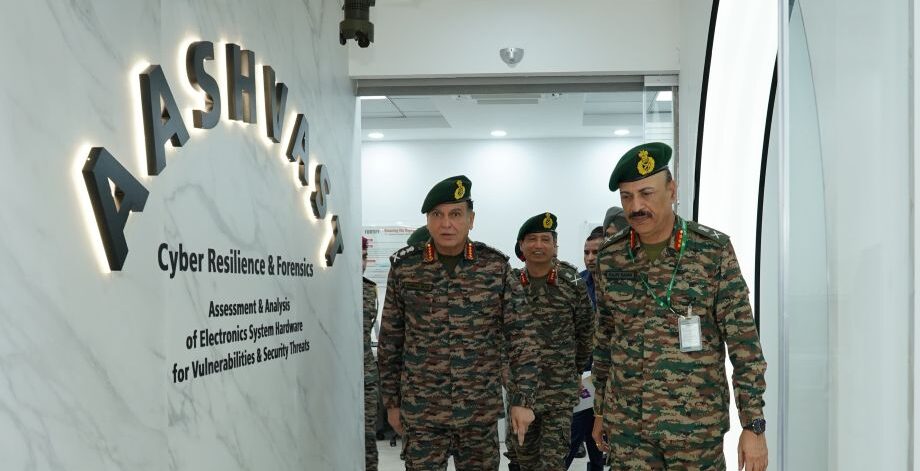
The Indian Army has strengthened its focus on the security of military electronics with the establishment of AASHVAST, a specialised facility designed to identify vulnerabilities in defence hardware, software and embedded systems. The facility has been set up at the Directorate General of Electronics and Mechanical Engineering (DG EME) headquarters in Delhi Cantonment and is intended to provide the Army with an in-house capability to assess the security and integrity of critical electronic systems.
AASHVAST stands for Assessment and Analysis of Electronic Systems Hardware for Vulnerabilities and Security Threats. The facility is designed to examine military electronic equipment at a deeper level, including the software and firmware that control the functioning of modern platforms. The initiative is particularly significant for unmanned systems such as military drones, where hidden vulnerabilities may not be identifiable through conventional physical inspections.
The AASHVAST facility was inaugurated by Chief of the Army Staff General Dhiraj Seth in New Delhi on August 14, 2026. According to the Army, the capability is aimed at improving the evaluation of critical defence platforms, strengthening cyber resilience and supporting operational readiness.
Modern military drones rely on a combination of flight-control systems, sensors, communication equipment, navigation technologies and embedded software. While physical inspections can establish whether a platform meets basic specifications, they may not reveal vulnerabilities hidden inside firmware or electronic components. AASHVAST is intended to address this gap by allowing specialists to examine the digital and electronic layers of such systems.
The facility can examine defence equipment for potential security concerns such as hidden passwords, embedded encryption keys, unauthorised remote-access mechanisms and undisclosed command pathways. It can also assess whether software updates are restricted to authorised sources, helping identify possible modifications or unauthorised changes to a platform.
One of the important areas of assessment involves military drones and their navigation systems. Unmanned platforms can be exposed to electronic warfare techniques such as GPS jamming and spoofing. While jamming can interfere with navigation signals, spoofing can provide false location information to a system. The AASHVAST capability can therefore help assess whether the navigation and location-security controls of an electronic platform are sufficiently resilient against such threats.
The Army is also examining the possibility of unauthorised foreign-origin components and software being present in sensitive defence equipment. Particular attention has been drawn to Chinese-origin components in military drones and other electronic systems. However, the purpose of such testing is to establish the origin, integrity and security of components and software rather than automatically treating every foreign-origin component as malicious.
The need for such capability has grown as unmanned systems and digitally enabled military platforms become increasingly important in modern warfare. A drone can appear completely compliant during a conventional inspection while vulnerabilities may remain concealed in its flight controller, firmware, communications architecture or other embedded electronics. Identifying such weaknesses before a system is used for sensitive missions can reduce potential operational and cybersecurity risks.
AASHVAST is reported to operate as an air-gapped, read-only assessment environment, allowing electronic systems to be examined without connecting them to external networks or modifying the equipment under evaluation. The facility can analyse software extracted from systems such as flight controllers and camera payloads, or examine stored software images. Identified vulnerabilities can then be assessed according to their severity and compiled into a security assessment.
The establishment of AASHVAST also reflects the Indian Army’s broader effort to strengthen indigenous capabilities in defence technology and reduce vulnerabilities associated with complex global supply chains. As India expands domestic production of drones, electronic warfare systems, sensors and other military technologies, the ability to independently verify the security of hardware and software is becoming increasingly important.
The initiative is expected to contribute to the Army’s efforts to improve the reliability and cyber resilience of mission-critical equipment. It also provides an additional layer of technical validation for defence systems at a time when electronic warfare, cyber threats and supply-chain security are becoming closely connected to battlefield effectiveness.
With AASHVAST, the Indian Army is moving beyond conventional equipment inspection towards a more comprehensive approach that examines the electronic and software foundations of modern military systems. The new capability could play an important role in ensuring that critical platforms are not only physically fit for service but are also secure, reliable and resilient against emerging technological threats.