


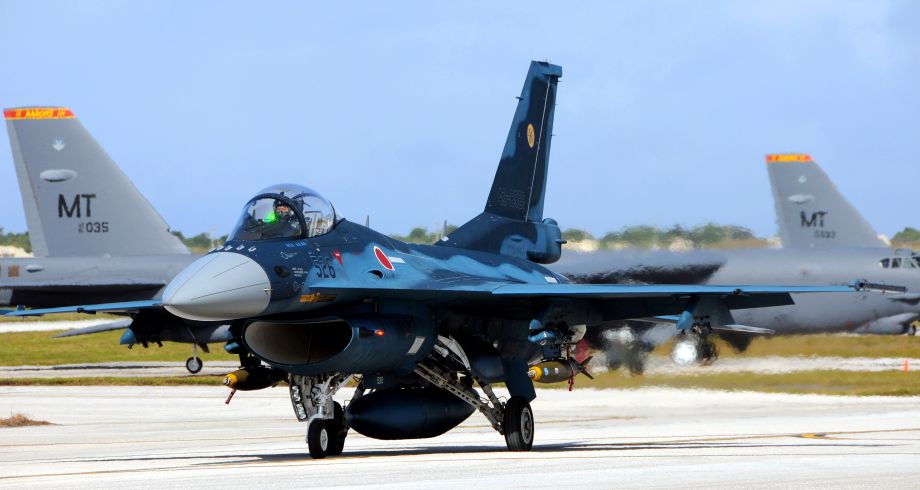
The Indian Air Force (IAF) is set to gain valuable operational insights into Japan’s Mitsubishi F-2A fighter aircraft during the upcoming Exercise Veer Guardian 2026, as Japanese fighter jets prepare to operate from an Indian air base for the first time. The bilateral air-combat exercise between the IAF and Japan Air Self-Defense Force (JASDF) is scheduled to take place at Air Force Station Jodhpur in Rajasthan in September.
The deployment is strategically significant because the F-2A has its origins in the American F-16 Fighting Falcon design. Although the Japanese aircraft has been substantially redesigned and incorporates several indigenous systems, its aerodynamic lineage gives Indian pilots an opportunity to train against an aircraft with characteristics broadly related to Pakistan’s F-16 fleet. Reports indicate that three F-2A fighters are being deployed for the exercise along with Japanese personnel.
For the IAF, the exercise offers an important opportunity for dissimilar air combat training, allowing Indian fighter pilots to study the flight characteristics, tactics and operational capabilities of an unfamiliar combat aircraft. This could be particularly useful in developing tactics against F-16-class platforms and improving the IAF’s understanding of potential air-combat scenarios in the region.
The Mitsubishi F-2 is not simply an F-16 operated under a different designation. Developed by Mitsubishi Heavy Industries in cooperation with Lockheed Martin, the F-2 features a larger wing, an extended fuselage and enlarged horizontal stabilisers compared with the original F-16 design. These changes provide greater fuel capacity, payload flexibility and improved operational characteristics.
The aircraft also introduced advanced Japanese technologies. The F-2 became the world’s first production fighter to enter service with an active electronically scanned array (AESA) radar, giving it sophisticated detection and tracking capabilities. Its Japanese-developed flight-control systems and electronic warfare capabilities further distinguish it from the F-16.
The F-2 was designed as a multirole fighter but has a particularly strong emphasis on maritime strike and coastal defence. Its capabilities therefore make the aircraft relevant not only to air-combat training but also to the broader maritime-security interests shared by India and Japan across the Indo-Pacific.
Exercise Veer Guardian 2026 will also have wider significance for India-Japan defence cooperation. The exercise is designed to improve interoperability, operational coordination and mutual understanding between the two air forces. The 2026 edition represents a major step forward because Japanese fighter aircraft are operating from Indian territory for the first time during a bilateral exercise.
The Japanese contingent has already begun arriving in Jodhpur ahead of the exercise, with Japanese C-2 transport aircraft supporting the deployment. The exercise is expected to involve integrated air-combat training between Japanese F-2A fighters and Indian fighter aircraft.
Beyond the immediate training value, the F-2 deployment provides the IAF with an opportunity to deepen its understanding of modern fighter sensors, electronic warfare systems and air-combat tactics. The experience could contribute to improving Indian tactics and operational preparedness against a range of fourth-generation fighter threats.
The exercise also reflects the expanding strategic relationship between New Delhi and Tokyo. With both countries increasingly focused on maintaining a stable and secure Indo-Pacific, regular air-force engagements are becoming an important component of their broader defence partnership.
For the IAF, however, the F-2 deployment carries a particularly practical benefit: the opportunity to train against a fighter with an F-16-derived design while simultaneously gaining exposure to Japan’s indigenous advances in radar, electronic warfare and combat aviation. The lessons from Veer Guardian 2026 could therefore have significance well beyond the duration of the exercise.