

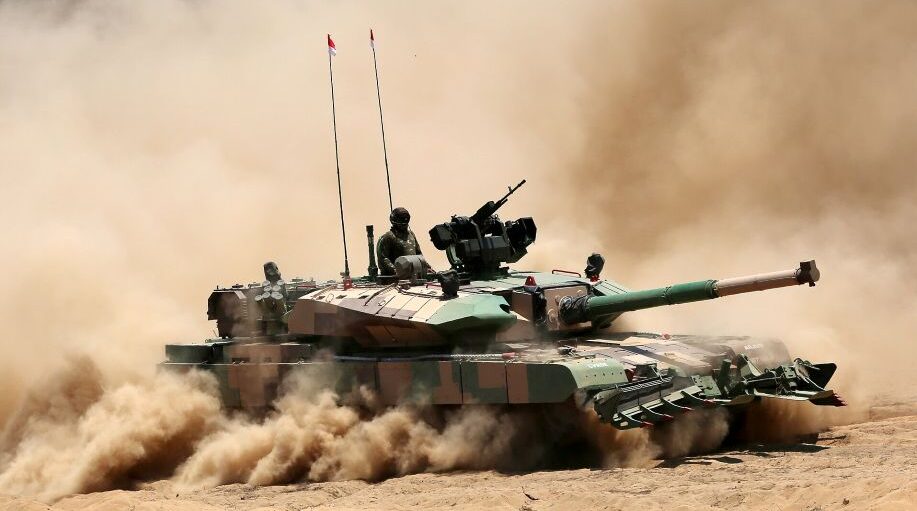
The Indian Army has finally begun the long-delayed overhaul of its Arjun Mk-1 main battle tanks, with two tanks entering a pilot overhaul programme at the Heavy Vehicles Factory (HVF) in Avadi near Chennai. The initiative comes around six years after the first Arjun tanks were scheduled for their initial major overhaul.
The two tanks will undergo a complete strip-down and rebuild rather than routine maintenance. As part of the pilot programme, they will also receive 26 upgrades drawn from the newer Arjun Mk-1A configuration. The repair procedures, technical practices and assembly process sheets developed during this exercise are expected to provide a standard framework for overhauling the remaining 124 Arjun Mk-1 tanks currently in Army service.
The overhaul programme addresses a long-standing maintenance gap in the Arjun fleet. A Comptroller and Auditor General (CAG) performance audit had earlier identified that the first overhaul was due in 2020, while the Army had yet to establish a dedicated arrangement for carrying out the work. Previous audits also highlighted problems involving spare parts availability and the absence of adequate repair infrastructure, which affected the operational availability of the tank fleet.
The pilot rebuild is also significant because the Army and industry do not have a comprehensive set of established overhaul procedures for the complete Arjun Mk-1 platform. As the two tanks are dismantled, engineers will assess individual components and develop repair procedures where documentation is unavailable. This makes the first two vehicles important not only as refurbished tanks but also as a basis for creating a repeatable overhaul methodology for the wider fleet.
Of the 26 planned upgrades, six are classified as major improvements. These include a commander’s panoramic sight, an Mk-2 gunner’s main sight, an automatic target tracker, an improved muzzle reference system, upgraded tracks and an advanced running gear system. The remaining upgrades focus on systems such as auxiliary power, fire detection and suppression, lighting, dust protection and periscope heating.
The programme involves several specialised facilities and defence suppliers. The tank engine is to be handled by Engine Factory Avadi, while the transmission and final drive will undergo work through RENK’s Indian operations. The 120 mm gun and cradle are to be serviced by Advanced Weapons and Equipment India, while the gun control system is linked to Bosch Rexroth in Germany. Other components, including tracks, batteries, gyros and sighting-related equipment, are expected to involve Indian suppliers.
The maintenance challenge has been closely connected to the Arjun Mk-1’s relatively high dependence on imported components. A 2017 CAG assessment cited in the latest reporting found that around 69% of the Mk-1’s content was imported when it entered service, with components sourced from multiple foreign suppliers. Such dependence has complicated long-term sustainment as some original suppliers have exited the market or changed their product lines.
The Arjun Mk-1 is powered by a 1,400 hp engine and uses a 120 mm main gun. Armoured Vehicles Nigam Limited (AVNL), which oversees the Heavy Vehicles Factory, describes the Arjun as an indigenous main battle tank designed for high firepower, mobility and protection. The company’s current specifications list the Mk-1 at about 58.5 tonnes, with a four-member crew and a maximum road speed of up to 70 km/h.
Following the rebuild, the two pilot tanks are expected to undergo a sequence of stand tests, stability checks and running trials, followed by limited validation trials at the Pokhran range in Rajasthan. The refurbished vehicles will carry a warranty of 24 months or 150 engine hours, whichever comes first.
The development comes as the Army continues to expand its focus on armoured vehicle readiness and lifecycle support. On August 27, the Ministry of Defence also announced a ₹472-crore T-series tank overhaul project at Vehicle Factory Jabalpur, aimed at creating facilities to overhaul T-72 and T-90 tanks at a planned capacity of 80 tanks per year.
Meanwhile, the Army is still awaiting the delivery of 118 Arjun Mk-1A tanks ordered from HVF in 2021 under a ₹7,523-crore contract. The Mk-1A incorporates major improvements over the Mk-1 and is intended to provide enhanced firepower, mobility and survivability. AVNL states that the Mk-1A incorporates numerous improvements over the earlier Arjun variant.
The launch of the Arjun Mk-1 overhaul programme therefore represents an important step toward extending the service life of the Army’s existing indigenous tank fleet. More importantly, the two-vehicle pilot project could provide the technical and industrial foundation needed to establish a structured overhaul cycle for the remaining Arjun Mk-1 tanks.